Traders Daily vs Weekly Review: 7 Use Cases
A practical collection to help traders choose daily vs weekly reviews for consistent improvement—compare where each rhythm wins, match it to seven real trading use cases, and apply templates, reset protocols, change logs, and KPI-focused drills without adding busywork.
Traders Daily vs Weekly Review: 7 Use Cases
A practical collection to help traders choose daily vs weekly reviews for consistent improvement—compare where each rhythm wins, match it to seven real trading use cases, and apply templates, reset protocols, change logs, and KPI-focused drills without adding busywork.
Are you reviewing your trades every day and still not improving—or skipping reviews for a week and feeling like you’re flying blind? The right cadence isn’t about discipline; it’s about matching your review rhythm to your strategy, time, and emotional state.
This collection breaks down when daily reviews beat weekly ones (and vice versa), then walks you through seven common scenarios—from high frequency to swing trading to performance plateaus. You’ll leave with simple focus points, add-ons, and guardrails you can use immediately.
Choose Your Review Rhythm
Your review cadence is a constraint, not a preference. A scalper with 30 trades a day needs different feedback than a swing trader with three.
Pick the rhythm that matches your goals and your bandwidth, not your guilt. The right choice feels a little boring.
Daily Review Wins
A daily review is a 10–20 minute debrief after the session, focused on execution. The core benefit is a tight feedback loop that fixes small errors before they compound.
Think “missed stop,” “late entry,” or “I sized up after a loss.” If you want cleaner reps, go daily.
Weekly Review Wins
A weekly review is a longer, scheduled audit of your trades to spot repeatable patterns. The core benefit is strategy alignment, where you separate signal from the week’s noise.
This is where you catch “my edge worked, my filters didn’t,” or “I’m overtrading chop.” If you want better decisions, go weekly.
Quick Self-Assessment
Answer these fast, then pick the cadence that fits. Be honest, not aspirational.
- Time available per day
- Trade frequency per week
- Strategy type and holding time
- Emotional volatility after losses
- Data quality in your journal
If two bullets feel shaky, start weekly and add daily later.
Use Case 1: High Frequency
If you place lots of trades, small mistakes compound fast. A daily review catches errors while they’re still cheap, like a “why did I chase that breakout?” moment you can fix tomorrow.
Use Daily When
High-frequency styles create more data, more variance, and more chances to drift. Review daily when your trade count is high enough to hide patterns.
- Scalping multiple times per session
- Day trading with frequent entries
- Getting many partial fills
- Using tight stops often
- Seeing repeated slippage issues
If you take 10+ trades a day, you’re running a process, not “taking a trade.”
Daily Review Focus
Your edge can survive market noise, but it won’t survive sloppy execution. Keep the daily review centered on mechanics you can correct immediately.
- Track execution metrics per setup
- Log missed entries and exits
- Measure spread and slippage by time
- Flag rule breaks with a label
- Tag screenshots for pattern recall
Fix execution first, then evaluate strategy.
Weekly Add-On
Add one weekly pass to validate your edge across enough trades to matter. It also stops you from “optimizing” your rules around one ugly Tuesday that won’t repeat. Use a structured, time-boxed process like this weekly trade review framework to keep changes grounded in enough data.
Use Case 2: Swing Trading
Swing trades breathe. They develop over days, not minutes, so signal quality beats micro-execution. If your edge sounds like “buy the pullback to weekly support,” you’re in weekly territory.
Use Weekly When
Your process should match your holding period and your stop distance. Weekly reviews work when the chart needs time to prove you right.
- Hold positions for multiple days
- Enter near end-of-day closes
- Use wider, structure-based stops
- Place fewer, higher-conviction trades
- Trade higher-timeframe setups
Weekly cadence keeps you from “managing” noise that was never part of the plan.
Weekly Review Focus
Your weekly review should protect the thesis, not your ego. You’re checking whether the trade still matches the market you’re in.
- Validate the setup still holds
- Confirm alignment with context
- Re-check position sizing vs risk
- Define hold and exit logic
- Record regime and volatility notes
Treat it like maintenance on a system, not a post-mortem.
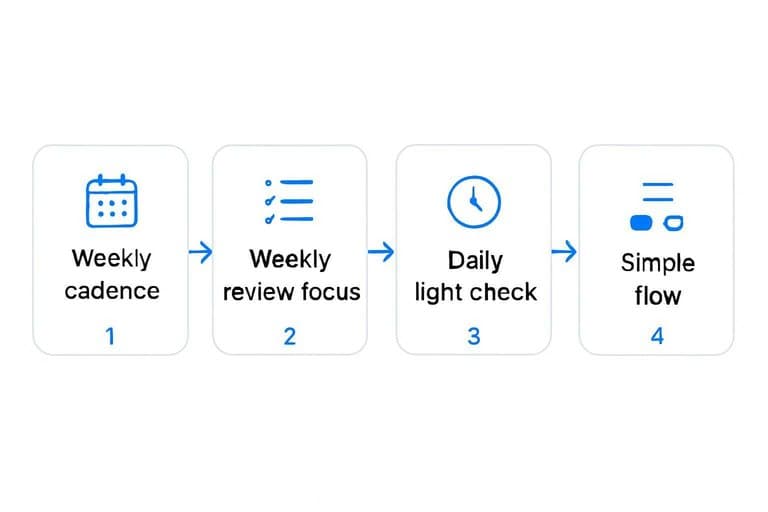
Daily Light Check
Do a five-minute daily check to stay informed without spiraling into over-management. Think “alerts, risk, headlines,” not deep journaling.
A simple flow: scan triggered levels, confirm stops and size, then read any market-moving news. If nothing changed, close the platform.
The goal is to avoid surprise, not to find a new trade every day.
Use Case 3: New Trader
Early on, your edge is not your strategy. It’s your routine. A daily review builds the habit of asking, “Did I follow rules?” before you ask, “Did I make money?”
Daily Learning Loop
Beginners improve fastest with tight feedback. Daily reflection catches small rule breaks while they are still cheap.
A simple scorecard works. Track 1–2 execution metrics like “rules followed” and “sizing correct,” plus one note on emotion. Write one sentence: “I chased because I feared missing the move.”
That loop turns trading into training, not gambling.
Starter Daily Template
Use the same five prompts every session. Consistency beats detail.
- Record your thesis in one sentence.
- Note which rules were met or missed.
- Name the strongest emotion you felt.
- Write one improvement for next time.
- Choose tomorrow’s single focus.
If you can’t fill this in, you’re not ready for a weekly review.
Graduation Criteria
Switch to weekly once behavior is stable. Until then, daily is your guardrail.
- Log 20 sessions minimum
- Rule breaks trend downward
- Keep sizing stable
- Write a pre-trade plan consistently
Graduate when execution is boring, because boring is where consistency starts. For a lightweight end-of-day structure, use this daily review checklist.
Use Case 4: Emotional Tilt
Tilt turns a good plan into “just one more trade” thinking. Daily review is your damage control when emotions hijack execution. Weekly review becomes useful once your reactions are boring and repeatable.
Daily When Tilted
You use daily review when the mistake is emotional, not technical. You’re trying to catch the pattern fast, before it compounds.
- Revenge trade after a red trade
- Impulsive add to avoid a loss
- Break max loss to “get it back”
- Overtrade after a big win
If any one shows up, your edge isn’t the problem. Your state is.
Reset Protocol
When you feel heat, follow the same script every time. The goal is to interrupt momentum and restore constraint.
- Pause trading for 20–60 minutes.
- Review your last three trades, including entries and exits.
- Name the trigger in one phrase, like “need to be right.”
- Set one guardrail for today, like one more trade max.
- Resume with smaller size, or stop if you hesitate.
Your protocol is your edge when your mind isn’t.
Weekly Stabilizer
Weekly review is for themes, not confessions. You track recurring triggers, the coping actions you used, and which guardrails actually held. You’re building a personal “tilt playbook” that says, “When X happens, do Y,” and you update it with evidence.
Once the same trigger gets the same calm response, you’ve earned the right to zoom out. That’s when weekly review starts paying more than daily.
Use Case 5: Strategy Changes
When you change a trading system, you’re running an experiment. Weekly reviews keep you from chasing “Tuesday was weird” noise while the new rules settle. Add a lightweight daily check only to confirm you’re executing the change as written.
Weekly for R&D
Strategy tweaks need a real sample, not a mood swing. A weekly cadence batches results so you can see signal through the chop, like testing a new exit rule over 30–50 trades instead of three.
Treat each week like one data point: track the same metrics, compare to your baseline, and avoid midweek “one more tweak” impulses. If you can’t wait a week, the change is probably underspecified.
Weekly review is where the system earns the right to exist.
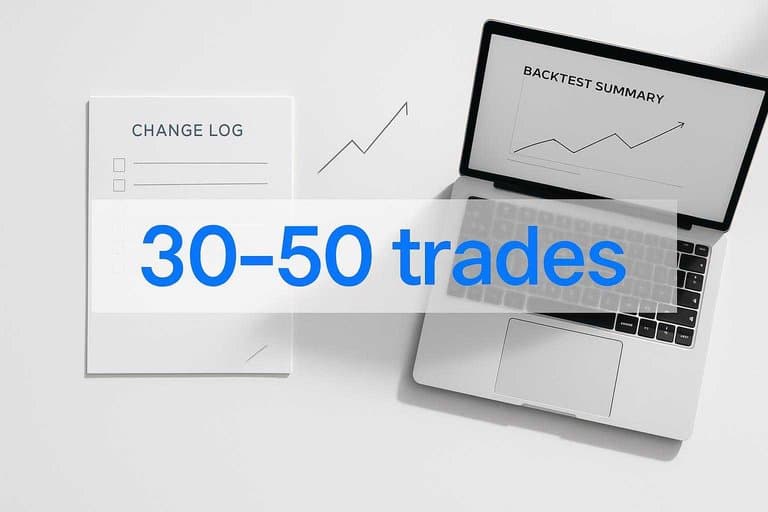
Change Log Checklist
Write the change down before you trade it, or you’ll rewrite history after. Keep one log entry per change so you can attribute outcomes cleanly.
- State the hypothesis in one sentence
- Specify the exact rule change
- Define the expected metric shift
- Set a sample size target
- Write a clear rollback condition
If you can’t write the rollback condition, you’re not testing. You’re hoping.
Daily Guardrails
Daily reviews during a rollout are for compliance, not performance. You’re checking whether you followed the new rules, not whether today’s P&L “proved” anything.
- Trade smaller while rules change
- Take strict entry and exit screenshots
- Tag trades that used new rules
- Note confusion points immediately
- Stop trading if execution drifts
Your edge can survive a bad day. It won’t survive sloppy implementation.
Use Case 6: Limited Time
You don’t need a perfect daily review to stay consistent. Use a weekly review for real analysis, and keep a tiny daily note so your week still has context.
Think “minimum viable continuity,” not “missed days.”
Weekly Deep Work
When time is tight, your weekly review becomes your main improvement loop. The goal is one clear fix, not a 30-tab autopsy.
- Export trades into one sheet or journal view.
- Categorize by setup, timeframe, and market regime.
- Compute key metrics like win rate, R-multiple, and max drawdown.
- Pick one fix with the biggest expected payoff.
- Schedule the next week’s experiments on your calendar.
If you can’t name the one fix, you didn’t review yet.
Two-Minute Daily Note
You’re not doing a daily review here. You’re leaving a breadcrumb trail your weekly self can trust.
- P/L number and size
- Best trade and why
- Worst mistake and trigger
- One emotion you noticed
- Tomorrow’s risk plan
These five lines prevent “I think I remember” from running your process.
Avoiding Backlog
Backlog is what turns journaling into a guilt project. Your rule is simple: never “catch up” with full detail.
If you miss a day, write one line: “No trades” or “Traded tired, broke rule X.” If you miss a week, do the weekly review and skip daily reconstruction. Your notes exist to support decisions, not to satisfy a record-keeping fantasy.
Batching works only when you batch the minimum.
Use Case 7: Performance Plateau
A plateau usually means you’re repeating the same mistake in a cleaner way. Use the weekly review to spot the leak, then use the daily review to fix one thing on purpose.
Weekly Leak Hunt
Your P&L is the scoreboard, not the diagnosis. The weekly review is where you slice results until one pattern says, “Here.”
- Group trades by setup type
- Segment by time of day
- Split by instrument traded
- Compare by holding time
- Tag by volatility regime
- Flag news exposure
When one slice keeps bleeding, you’ve found a repeatable leak, not a “bad week.”
One KPI to Fix
Weekly insights die when you chase five fixes at once. Pick one KPI that sits closest to the leak, like “rule adherence” or “average R-multiple,” and make it your only objective.
If you can’t measure it daily, you can’t change it daily.
Daily Micro-Drills
You don’t need motivation. You need a tiny drill that turns the KPI into a habit.
- Set a KPI target for tomorrow, like “95% rule adherence.”
- Predefine a cue, like “pause before order entry.”
- Track the KPI on every trade, not just losers.
- Score the day in one number at the close.
- Adjust one constraint for tomorrow, like smaller size or fewer trades.
Treat each day like a lab, and your plateau turns into a process change.
Pick a Cadence, Then Run It for 4 Weeks
- Choose your default rhythm based on your main use case (daily for execution/emotion, weekly for systems/strategy).
- Add the lightweight counterpart: a two-minute daily note if you’re weekly-first, or a weekly “big picture” check if you’re daily-first.
- Set one review output you must produce (a rule tweak, a top mistake to eliminate, or one KPI to improve) and track it for four weeks.
- Reassess at the end: keep the cadence if outcomes improved, or switch rhythms if you’re generating notes without behavior change.
Frequently Asked Questions
Is a traders daily review the same as journaling every trade?
Not exactly. A traders daily review summarizes the day’s decisions, rule adherence, and biggest mistakes, while trade journaling records each trade’s setup, entry/exit, and screenshots.
What should I include in a traders daily review template?
Track 5–8 fields: market context, planned vs executed trades, rule violations, best trade/worst trade, one lesson, one fix for tomorrow, and key stats like R-multiple and win rate.
How long should a traders daily review take to be effective?
Most traders get strong results with 10–20 minutes per day. If it regularly takes longer than 30 minutes, reduce fields and focus on one behavior change you’ll execute next session.
How do I measure whether traders daily reviews are improving my performance?
Compare a 4-week baseline to the next 4 weeks using metrics like rule-violation rate, average R per trade, and max drawdown. Most improvements show up first in fewer mistakes before higher profits.
Can I do a traders daily review if I use copy trading or automated strategies?
Yes—shift the focus from entries to system oversight. Review whether the bot matched expected behavior, slippage and fees stayed within limits, and any parameter changes or outages occurred.
Turn Reviews Into Action
Whether you review trades daily, weekly, or both, the real challenge is turning insights into a repeatable watchlist that fits your time and market regime.
Open Swing Trading streamlines daily stock selection with relative strength rankings, breadth, and sector/theme rotation context—get 7-day free access with no credit card.
Sources
- The Weekly Trade Review Process That Actually Improves Your Trading (TradeZella) — referenced in Weekly Add-On
- Trading Journal Daily Review Checklist (WealthBee) — referenced in Graduation Criteria