
What “Market Daily” Means for Breakout Traders
An explainer for breakout traders on what “Market Daily” really means and how to use it—clarify the definition vs. common misconceptions, understand daily timeframe mechanics and gaps, spot breakout-friendly regimes and internal signals, and place triggers/stops/targets with cleaner logic.
What “Market Daily” Means for Breakout Traders
An explainer for breakout traders on what “Market Daily” really means and how to use it—clarify the definition vs. common misconceptions, understand daily timeframe mechanics and gaps, spot breakout-friendly regimes and internal signals, and place triggers/stops/targets with cleaner logic.
You think you’re trading a breakout, but the “daily” you’re reacting to is often a mashup of overnight gaps, compressed information, and shifting liquidity. That’s how clean levels turn into false triggers.
This explainer reframes “Market Daily” as a decision layer—not a vibe. You’ll learn what the daily bar actually captures, how regime and internals change breakout odds, and how to translate that context into better trigger placement, stops, and realistic targets.
Define Market Daily
Market Daily is your daily, time-boxed snapshot of market state that directly feeds breakout decisions. It answers “what environment are we trading today?” not “what happened yesterday?” Think of it like a pre-flight checklist you run at 8:30–9:00 a.m., then you stop.
Core definition
Market Daily is a repeatable, once-per-day read of the market’s current regime, captured in a fixed time window. You use it to decide how aggressive to be on breakouts, like “tighten triggers in choppy tape” or “press follow-through in trending tape.” It’s a snapshot built for action, not a running commentary.
The edge comes from consistency. Same inputs. Same time. Same decisions.
Why traders use it
You use Market Daily to keep breakout trades aligned and timed, even when the tape gets loud.
- Match setups to the current regime
- Standardize scan and trigger timing
- Reduce impulsive mid-day rule changes
- Anchor risk to a daily baseline
You’re building a decision loop, not collecting opinions.
What it is not
Market Daily prevents category errors that wreck breakout execution.
- Not a market prediction
- Not a personal watchlist
- Not a news or earnings digest
- Not a single indicator read
If it turns into a story, you’ve already drifted off process.
Breakout lens
In breakout terms, “daily market state” means four practical dials: volatility, trend pressure, liquidity, and catalyst risk. Volatility tells you whether breakouts can expand or will whipsaw. Trend pressure tells you if follow-through is common or rare.
Liquidity and catalyst risk decide whether your triggers are tradable, or just theoretical. That’s the line between a clean breakout and a trap.
Timeframe Mechanics
“Market Daily” is a behavior claim, not a calendar label. Daily bars sample one full session, include an overnight repricing, and reset at a fixed boundary. That structure makes breakout signals look cleaner than intraday, and more actionable than weekly, but it also changes where you’re actually getting filled.
Daily bar physics
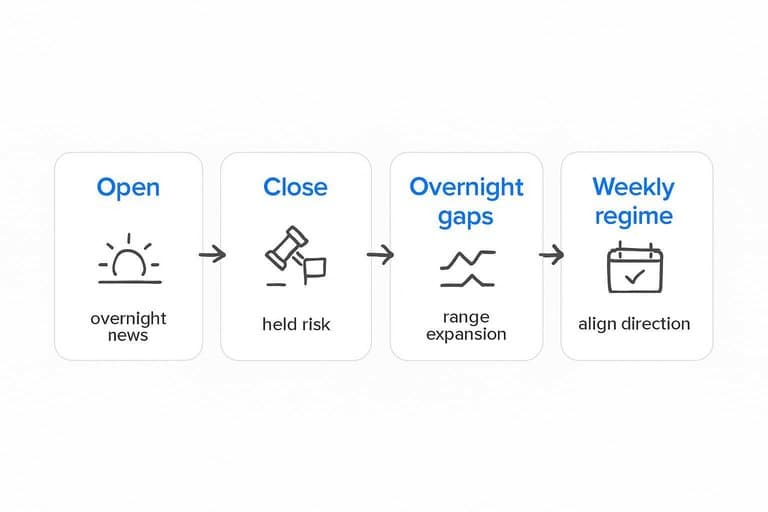
Daily breakouts live and die on where the market opens and closes, because those prints anchor everyone’s reference points. When you trigger off a daily high, you’re betting the close will defend it.
A daily bar is built around session boundaries and closing auctions. The open sets the first consensus after overnight news. The close locks in who held risk. Gaps become instant “range expansion” without trading through the middle. That’s the line that gets crossed.
If the close can’t hold above the level, your “breakout” was just a tour.
For more on how the close gets set, see Nasdaq’s explainer on auction price discovery.
Information compression
Daily candles compress thousands of intraday decisions into one datapoint, which is why they feel stable. You get fewer signals, but each one carries more consensus.
Compression cuts both ways. Intraday failure patterns vanish inside a strong-looking close. A late-day squeeze can paint a breakout that was weak all day. A midday rejection can disappear if the close recovers. Your backtest may “see” strength your execution never had.
If you don’t know the day’s path, you don’t know your real risk.
Overnight gap factor
Overnight repricing changes what a breakout even is, because the market can jump your levels. You need rules for gaps, not hope.
- Place stops beyond gap extremes, not yesterday’s close.
- Size from worst-case gap, not average true range.
- Prefer triggers after the open, not on the print.
- Skip breakouts that open far above your entry.
- Treat gap fills as separate setups.
If gaps can move you more than your planned risk, it’s not a tradable breakout.
Weekly alignment
Daily breakouts work best when they expand in the same direction as the weekly regime. Weekly context tells you whether you’re trading expansion or fighting mean reversion.
- Trade up-breakouts above rising weekly structure.
- Trade down-breakouts below falling weekly structure.
- Avoid breakouts into weekly supply or demand zones.
- Reduce aggression inside weekly ranges.
- Require stronger closes when counter-weekly.
Align the regime first; the breakout is just the trigger.
If you want a framework, this guide on multi-timeframe analysis lays out the alignment logic clearly.
Regime Drives Breakouts
A Market Daily is a regime read, not a news recap. Your breakout win rate and failure mode change when the regime changes, even with the same chart pattern.
Three breakout regimes
Trend expansion is directional pressure with follow-through, where breakouts tend to run and hold levels. Mean-reversion chop is balanced flow, where breakouts often fade back into the range within hours or days. Transition is regime change in progress, where breakouts work, then fail, then work again, often around obvious levels like “the prior highs.”
Volatility expansion
When range expands, your Market Daily should say it plainly, because distance becomes available. Look for these signals:
- ATR rising for several sessions
- Gaps appearing more often
- Wide-range days clustering
- Intraday swings stretching
- Breaks holding past close
In this regime, stops must widen, but winners can pay you back quickly.
Compression setup logic
Tight ranges matter because they define risk, but participation is what loads the spring. When volume, breadth, or relative strength rises inside a narrow base, you get clean levels that many traders see and fewer random wicks that stop you out. Think “three weeks tight, volume up,” then one decisive push through the trigger.
Distribution traps
High volatility with weak participation is where breakouts go to die, fast. Your Market Daily should flag these tells:
- Volatility elevated, breadth falling
- Leaders breaking, laggards rising
- Big up opens, weak closes
- Breakouts failing within 1-3 bars
- Support breaks quickly reclaimed
If you keep trading clean breakout rules here, you’re paying tuition to the regime.
Internals That Matter
“Market Daily” is your shortcut to the mechanics under price action. It tells you whether a breakout has real sponsorship or just a loud chart.
Breadth and participation
Breakouts stick when many stocks push with you, not a few heroes dragging the index. Narrow leadership looks strong until it snaps, because exits crowd fast.
Watch participation like it’s fuel, because it is. If advancers rise with new highs, pullbacks get bought and stops survive. If only mega-caps carry, breakouts fail more, gap against you more, and whipsaw becomes the default.
When breadth fades, trade smaller or faster, because follow-through gets rationed.
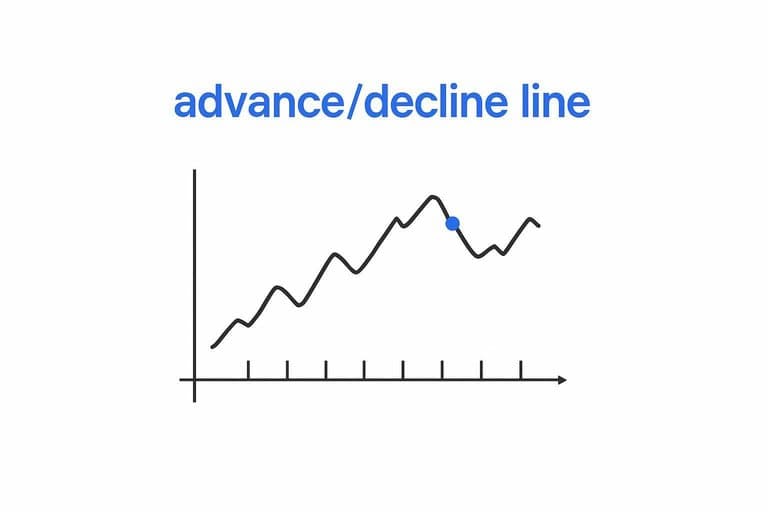
A classic way to track participation is the advance/decline line.
Volume and liquidity
Volume and liquidity decide whether your breakout is tradeable, not just “right.” They also decide how much your stops cost you.
- Rising volume confirms real demand, not just level-tapping.
- Widening spreads signal stress and worse fills.
- Thinning depth increases slippage on entries and exits.
- Sudden volume spikes can mark stop runs, not breakouts.
- Smooth volume build supports retests and second entries.
If spreads widen while price breaks out, assume the market is charging you a toll.
For a deeper market-structure view, the Fed paper on bid-ask spreads and market depth is a solid reference.
Rates and FX pressure
Rates and FX are the hidden hand on your P/E and your sector map. When they move, yesterday’s “clean” breakout can turn into a trap.
Higher yields raise discount rates, so long-duration growth breaks out less reliably. A stronger dollar squeezes multinationals and commodities, shifting leadership to domestic or defensive pockets. If “Market Daily” flags a rate or FX shock, expect rotation, not broad continuation.
Trade the leaders that fit the macro tape, not the ones you wish were leading.
Options positioning
Options flow can glue price to a level or slingshot it through. Dealers hedge, and that hedging becomes the motor.
- Positive gamma can pin price near big strikes.
- Negative gamma can amplify moves past breakout lines.
- Large call walls can slow upside follow-through.
- Put walls can cushion drops or snap when breached.
- Expiration weeks can flip behavior intraday.
If price “sticks” at your level, check gamma before blaming your setup—this breakdown of the gamma pinning effect explains the mechanism.
Trigger Placement Logic
Market Daily shifts your breakout trigger from “the nearest line” to “the day’s most defended line.” Your levels come from where the last session actually transacted size, like “yesterday’s high,” not where your chart looks clean.
Level selection
Your job is to pick levels that already have orders parked on them. Market Daily treats certain prices as liquidity magnets because many traders reference the same anchors.
- Mark prior day high and low as primary triggers.
- Add the most recent 3–5 day pivot high/low.
- Overlay a volatility band around the open or VWAP.
- Prefer levels that align across two sources.
When multiple references stack, breakout orders pile up and slippage jumps.
Confirmation rules
You need confirmation that price accepted the level, not just touched it. Market Daily confirmation focuses on evidence of participation.
- Require a close beyond the level.
- Require range expansion versus recent bars.
- Require volume above baseline for that time.
- Reject wicks that reverse immediately.
Confirmations cost you a few cents, then save you the full stop.
Stop mechanics
Stops work when they match today’s movement, not your comfort. Market Daily frames stops as “room for noise,” like a fraction of ATR, because a quiet day and a trending day punish the same fixed 12-cent stop differently.
If the daily regime is compressed, your stop can sit tighter behind the level. If the regime is expanded, your stop must widen or you’ll get clipped by normal rotation.
Set the stop from volatility first, then decide if the trade is still worth taking.
Target expectations
Targets should match how far the day tends to travel after a break. Market Daily links your R-multiple goals to the current volatility state.
- Low volatility: 0.5–1.5R, shorter holds.
- Normal volatility: 1–2.5R, standard holds.
- High volatility: 1.5–4R, wider swings.
- News-driven: scale out early, keep a runner.
Your target isn’t “what you want,” it’s what today can realistically pay.
Turn “Market Daily” Into a Repeatable Breakout Plan
- Name the regime first: decide whether you’re in expansion, compression-to-expansion, or distribution/mean-reversion before you even mark levels.
- Read the daily mechanics: note gaps, where the close sits in the range, and whether the weekly picture agrees with your direction.
- Check internals for permission: confirm breadth/participation, volume/liquidity quality, and any rates/FX or options positioning headwinds.
- Place triggers with rules: pick levels that matter to other traders, require confirmation (close/hold/volume), and define invalidation in advance.
- Size to the stop and set expectations: use a stop that matches the daily noise, then target based on regime (bigger in expansion, tighter in chop) rather than hope.
Frequently Asked Questions
Does “market daily” still matter for breakout traders in 2026 if I already use alerts and scanners?
Yes—most scanners find candidates, but a market daily helps you decide whether breakouts are worth taking at all by filtering for favorable conditions and avoiding low-follow-through days.
Do I need a market daily every day, or only on days I plan to trade breakouts?
Use it on every trading day you might place a trade, because breakout edge can flip quickly with macro events, options flows, and liquidity shifts; a 5–10 minute check is usually enough.
How do I measure whether my market daily is actually improving breakout performance?
Track your breakout stats by day-type (e.g., trending vs choppy) and compare win rate, average R, and max adverse excursion with and without the market daily filter over 30–50 trades.
Can I use a “market daily” process for swing breakouts, or is it only for day trading?
You can use it for swing breakouts by anchoring the read to the daily/weekly trend and risk context, then using it to size positions and choose which breakouts to skip when conditions are hostile.
What if I don’t have time to write a full market daily—what’s the minimum checklist that still helps breakout trades?
Focus on three inputs: index trend/volatility (e.g., SPY + VIX), breadth (advance/decline or up/down volume), and leadership (sector relative strength); if 2 of 3 are aligned, breakouts usually follow through more often.
Turn Market Daily Into Leaders
Reading the daily tape is straightforward; translating regime, internals, and trigger logic into a focused breakout watchlist every session is the hard part.
Open Swing Trading streamlines stock selection with daily RS rankings, breadth, and sector/theme rotation context—so you can find actionable breakout leaders faster. Get 7-day free access with no credit card.
Sources
- Nasdaq: Automation and information produce efficient price discovery in Nasdaq’s auction process (NOII; opening/closing crosses) — referenced in Daily bar physics
- FXEmpire: Multi-timeframe analysis—using higher timeframe (weekly/daily) to set trend context, lower timeframe for entries — referenced in Weekly alignment
- Britannica Money: Advance/Decline (A/D) Line definition; breadth/participation; divergences vs cap-weighted indexes — referenced in Breadth and participation
- Federal Reserve FEDS paper (2025): liquidity measures such as bid-ask spreads and market depth; execution/impact context — referenced in Volume and liquidity
- SpotGamma Support: Pin/Pinning effect from Gamma (dealer hedging near strikes; price gravitates to ‘pinned’ strikes) — referenced in Options positioning