Why High Stocks Trades Fail From Bad Sizing
A practical troubleshooter for why high-priced stock trades blow up from bad sizing — spot failure symptoms, define true R, account for stop distance/liquidity/leverage, and apply sizing rules (plus options-specific sizing with delta and defined-risk structures).
Why High Stocks Trades Fail From Bad Sizing
A practical troubleshooter for why high-priced stock trades blow up from bad sizing — spot failure symptoms, define true R, account for stop distance/liquidity/leverage, and apply sizing rules (plus options-specific sizing with delta and defined-risk structures).
Ever feel like high-priced stocks “move more,” so your trades must be riskier—even when you only buy a few shares? Most blowups aren’t about the ticker; they’re about sizing that ignores stop distance, volatility, and how much you can actually lose.
This troubleshooter helps you pinpoint the exact sizing mistake behind your losses, compute your true risk in dollars and R, and rebuild the trade from the stop outward. You’ll leave with clear sizing rules, order tactics, and an options sizing framework that doesn’t lie to you.
Failure Symptoms Map
Most “bad trades” in high-priced stocks are sizing problems in disguise. You feel it first as chaos: “I did everything right, and still got smoked.” The symptoms are repeatable, and they point to the same root cause.
Quick symptom checklist
These complaints show up when share size ignores stop distance and dollar risk. They’re common when you trade $200+ names like they’re $20 names.
- Repeated stop-outs on normal noise
- Panic exits before your plan triggers
- Oversized losses from one mistake
- Missed adds due to no room
- Avoiding valid setups after a hit
If you check three or more, your sizing is driving your emotions.
High-price stock traps
High-priced shares turn small sizing errors into big dollar mistakes. A $500 stock moving $5 is “only” 1%, but it’s $5 per share.
If you buy 200 shares, that’s $1,000 of heat before slippage. If your stop is wide, you can’t afford enough shares to matter. If your stop is tight, normal spread and prints tag you out.
That’s the line that gets crossed: price action stays normal, but your risk becomes extreme.
Two-minute self-test
Pull a small sample and let the numbers argue with you. Twenty trades is enough to reveal a sizing pattern.
- Export your last 20 trades into a sheet.
- Record R size, % risk, stop distance, and shares.
- Add max adverse excursion (MAE) for each trade.
- Mark outcome: win, scratch, or loss.
- Flag repeats: tight stops, big MAE, or outsized -R.
You’re not hunting “better setups.” You’re hunting the math that keeps breaking your plan.
Root Cause: Bad Sizing
High-priced stocks punish fuzzy sizing because each dollar of movement is real money. A great entry can still fail if your position size forces you to “hope” instead of execute.
Risk not defined first
If you pick shares before you pick the stop, your risk becomes a guess. Then every red candle turns into an argument with yourself: “Do I give it more room?”
Define the stop first, then back into shares from a fixed dollar risk. Example: you risk $300, your stop is $6 away, so you take 50 shares, not “whatever feels right.”
When shares come first, discipline becomes optional, and the market always charges for that.
Stop distance mismatch
Stops fail when they ignore how the stock actually trades. High-priced names can move $5–$20 like it’s nothing.
- Set stops tighter than ATR noise
- Set stops wider than your account allows
- Place stops on obvious round numbers
- Ignore liquidity and spread at the exit
Match the stop to volatility and the size to your account, or your “plan” is just a suggestion.
Dollar-risk illusions
“It’s only 10 shares” sounds small until the stock is $600 and your stop is $20 away. That’s $200 of risk per trade, before slippage, and slippage is rarely polite in fast names.
Commissions and spreads also hit small-share trades harder because the friction is a bigger percentage of your risk. Your P&L looks controlled, but your execution cost quietly eats the edge.
If costs move the needle, your size is already telling you the trade is marginal.
Leverage and margin creep
Margin makes sizing look safe right up until it isn’t.
- Check how much of the position uses margin, not cash.
- Watch buying power after partial fills and adds.
- Note whether you hold overnight with margin enabled.
- Recalculate risk using full exposure, not “available funds.”
Your account doesn’t care about your intent; it cares about your true exposure.
Diagnose Your Numbers
One broken trade can become your sizing template. Treat it like an audit, not a confession, and you’ll stop “feeling” risk.
Compute true R
Pick the exact numbers you would have sent to your broker, not the ones you remember later.
- Write your entry price and share count you intended.
- Set your planned stop price, then compute per-share risk: entry minus stop.
- Add a buffer for spread and slippage, like “+ $0.05 per share.”
- Compute $R: (per-share risk + buffer) × shares.
- Compute % account risk: $R ÷ account equity.
If you can’t write true R in 30 seconds, you’re trading vibes.
Volatility baseline
Your stop has to match the stock’s normal movement, not your comfort level. Use ATR or average daily range to sanity-check whether the stop is inside routine noise.
Example: if a stock’s ATR is $3 and your stop is $0.60, you’re betting on being right immediately. That’s not “tight risk,” it’s a probability tax.
When your stop is smaller than the stock’s breathing room, sizing becomes a coin flip.
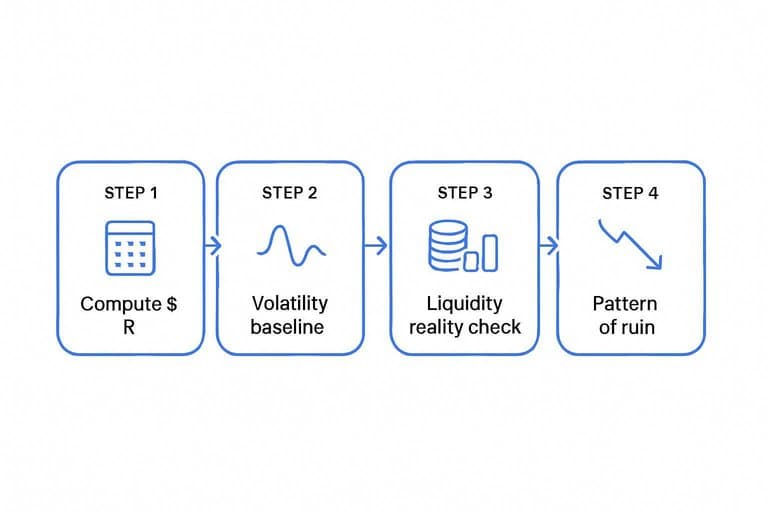
Liquidity reality check
Liquidity decides whether your theoretical stop behaves like a real stop.
- Check average daily volume for smooth fills.
- Measure bid-ask spread for hidden per-share risk.
- Scan order book depth for thin “air pockets.”
- Note time of day for opening and closing whipsaws.
If the spread is doing half your stop’s job, your sizing is already wrong.
Pattern of ruin
Over-R losses don’t need to be dramatic to break you. A few “only slightly bigger” losses stack into a drawdown that changes your behavior.
Example: risking 1% on paper, but taking 2% after slippage and panic exits, turns five losses into -10%. Then you cut size, skip setups, and abandon the plan right before it would recover.
Your strategy usually dies from sizing drift, not bad entries.
Sizing Rules That Work
High-priced tickers punish sloppy sizing because a small share count still swings big dollars. You need rules that translate volatility into consistent risk, like “$250 max loss per trade,” not vibes.
Here are sizing rules that hold up when price and volatility spike.
| Rule | How to size | When to use | Avoid when |
|---|---|---|---|
| Fixed dollar risk | Shares = risk ÷ stop | Most trades | No clear stop |
| ATR-based stop | Stop = 1–2× ATR | Volatile names | ATR is distorted |
| Percent-of-equity cap | Risk = 0.25–1% | New strategy | Tiny accounts |
| Notional exposure limit | Position ≤ X% equity | Margin accounts | Tight stop already |
| Options delta sizing | Shares ≈ contracts×100×delta | Options hedges | Wild IV shifts |
If your share count changes with volatility, your losses stop changing with ego.
Fix: Build the Trade
Expensive tickers punish vague sizing. You need a workflow that turns an idea into an order you can actually execute.
Set stop first
Your stop defines your risk. Without it, “position size” is just a guess.
- Choose a technical stop level, like “below last swing low.”
- Validate it against ATR so it’s not inside normal noise.
- Add an execution buffer for gaps and spreads.
- Reject trades needing stops you can’t afford.
If your stop is impossible, the trade is impossible.
Calculate shares correctly
Size from dollars-at-risk, not from “I want 10 shares.” High-price names make that mistake expensive.
- Pick a max risk percent per trade, like 0.5%.
- Compute shares = $risk ÷ per-share risk.
- Round down to whole shares.
- Confirm total exposure, buying power, and margin impact.
Your account doesn’t care about share count. It cares about dollars lost.
Use smarter orders
High-dollar names move fast, and market orders donate money. Your order type is part of sizing because slippage changes per-share risk.
Use a limit order when liquidity is decent and you can wait for your price. Use a stop-limit when you need confirmation, but you still refuse a terrible fill. Use staged entries when spreads widen, like “half now, half on a pullback,” so one bad print doesn’t wreck your average.
Your goal is simple. Control your fill price without turning every trade into a missed trade.
Scale without breaking risk
Scaling works when it’s planned. Random adds turn one loss into a portfolio event.
- Pre-plan add levels before the first entry.
- Re-calc blended stop after each add.
- Cap total R across all entries.
- Avoid averaging down past defined risk.
Adding is fine. Adding without math is how sizing fails.
For a clean sizing framework, use the position size formula (account risk ÷ per-share risk) before you add.
Special Cases: Options
Options on high-priced stocks make sizing errors louder because leverage hides inside the contract. One “small” trade can be 200 shares of exposure, plus wide spreads and fast Greeks.
Delta-based position sizing
Size options by delta exposure and max loss, not contracts-by-feel. Your goal is a stock-equivalent position with a known worst case.
Delta mapping is simple:
- Stock-equivalent shares = contracts × 100 × delta
- Dollar exposure ≈ stock price × stock-equivalent shares
- Max loss = premium paid (long options) or defined spread width (spreads)
Example: 2 calls with 0.35 delta ≈ 2 × 100 × 0.35 = 70 shares. If you would never trade 70 shares, you shouldn’t trade those two contracts either.
Once you think in shares and max loss, “one contract” stops feeling harmless.
IV and spread costs
Options add hidden sizing tax through pricing and mechanics. Those costs change your effective stop and your real R.
- Trade wide spreads, lose instantly on fills.
- Hold through IV crush, watch winners flatline.
- Buy near-expiry gamma, get whipped out fast.
- Ignore assignment risk, wake up overexposed.
If your stop is based on charts but your P&L is driven by Greeks, your sizing is fictional.
Defined-risk structures
If you can’t state max loss in dollars, you don’t have a position size. Defined-risk structures force the math to be honest.
- Convert naked calls or puts into vertical spreads.
- Set max loss as spread debit or width minus credit.
- Size contracts so max loss fits your risk budget.
- Validate liquidity: tight spreads and real volume.
- Write the exit: profit target, time stop, and rollback plan.
Defined risk doesn’t make trades safe, but it makes your sizing real.
Rebuild Your Next High-Price Trade From Risk First
- Set your stop before you set your shares—then define 1R as the exact dollar loss you’re willing to take.
- Calculate shares/contracts from stop distance (and delta for options), then sanity-check volatility, liquidity, and slippage so “paper risk” matches real fills.
- Lock the risk in with smarter orders and defined-risk structures when needed, and only scale after the trade proves itself—never by letting margin or leverage quietly expand your exposure.
Frequently Asked Questions
What counts as a “high stock” price for position sizing purposes?
Most traders treat $200+ per share as a high-priced stock because 100-share lots and $1–$3 intraday moves quickly create oversized dollar risk; for many accounts, $500–$1,000+ stocks require fractional shares or options to size correctly.
Do high stocks require a different stop-loss approach than cheaper stocks?
Usually yes—use volatility-based stops (like ATR) rather than a fixed dollar stop so your stop reflects the stock’s normal movement, then size shares to keep your $ risk per trade consistent.
How do I calculate position size for high stocks if my broker doesn’t support fractional shares?
Size by max dollar risk per trade and round down to whole shares; if that forces you into 0–1 shares, use defined-risk options (debit spreads) or switch to a broker/account that supports fractional shares for that ticker.
What’s a realistic risk per trade when trading high stocks in a small account?
Most traders use 0.25% to 1% of account equity per trade on high stocks to avoid large equity swings, and cap total open risk (all stops combined) around 2% to 5%.
How long should I paper trade high stocks before going live with real size?
Track at least 20–30 trades and verify your average loss stays near your planned $ risk and your max drawdown is tolerable; then scale size up in small steps (e.g., +25% risk) every 10–15 trades if metrics hold.
Size Smarter, Select Better
Once you’ve tightened your sizing rules, the next bottleneck is consistently finding high-stock leaders that fit your risk, volatility, and market regime.
Open Swing Trading helps you spot breakout-capable leaders with daily relative strength, breadth, and sector/theme context—so you can build trades around cleaner candidates. Get 7-day free access with no credit card.
Sources
- Wikipedia — Average True Range (ATR) definition and use as volatility input — referenced in Stop distance mismatch
- TraderLion Lesson — “Know Your Numbers First” (position size formula: account risk ÷ per-share risk) — referenced in Scale without breaking risk