
Why Mark Minervini setups fail in choppy markets
A practical troubleshooter for why Mark Minervini-style setups stop working in chop—diagnose the volatility/breadth regime, spot fuel-less breakouts and late-stage base traps, verify relative strength vs price, and adjust entries/stops with a chop-proof workflow.
Why Mark Minervini setups fail in choppy markets
A practical troubleshooter for why Mark Minervini-style setups stop working in chop—diagnose the volatility/breadth regime, spot fuel-less breakouts and late-stage base traps, verify relative strength vs price, and adjust entries/stops with a chop-proof workflow.
Your “perfect” VCP or pivot breakout looks clean… then it pops a percent, stalls, and stops you out—again. In choppy markets, Minervini-style strength can turn into a rapid-fire churn machine.
This troubleshooter helps you separate bad setups from a bad regime. You’ll learn how to diagnose chop, identify breakouts with no fuel and late-stage base traps, catch misleading RS, tighten entry timing, and rebuild stops and rules so you can trade less, cleaner, and with fewer repeated scratches.
Chop Diagnosis
Minervini-style breakouts need clean trends, tight ranges, and predictable follow-through. In chop, price fakes leadership and then snaps back, right after your “perfect” entry.
Price Action Tells
Chop shows up in the candles before it shows up in your P&L. Spot it early, because overlapping bars kill clean pivot breaks.
- Print overlapping bars for most sessions
- Cross above and below key MAs weekly
- Close near range midpoint repeatedly
If two show up, you’re trading noise, not a trend.
Volatility Regime Check
You want volatility that expands in your direction, not volatility that expands everywhere. Run this quick check before you treat any base as “tight.”
- Compare current ATR% to your 3-month ATR% baseline.
- Flag chop if ATR% rises without higher highs and higher lows.
- Check intraday range expansion with flat weekly closes.
When volatility rises and progress stalls, your stops become magnets.
Breadth Reality Test
Breakouts stick when the market is paying you for being right. If advance/decline is weak, 52-week highs are scarce, and sectors are scattered, breakouts act like “one-stock stories.” That’s when your best-looking chart becomes a quick round trip.
Volume Clue Filter
Volume tells you who’s in control, even when price looks fine. Use these as veto signals, not trivia.
- Reject high-volume reversals near highs
- Count heavy down days in the index
- Distrust breakouts on average volume
- Avoid bases with declining up-volume
If institutions sell into strength, your breakout becomes their liquidity.
Breakouts With No Fuel
Chop creates breakouts that look valid, then stall because there’s no real urgency behind them. You’ll see the classic “clean trigger, instant regret” tape, like a breakout that closes flat on heavy volume.
| Failure symptom | Likely chop-driven cause | Immediate adjustment |
|---|---|---|
| Breaks out, closes flat | Breakout buyers absent | Demand strong close |
| Pops, reverses next day | Overhead supply nearby | Wait for retest |
| High volume, no progress | Rotation, not accumulation | Size down fast |
| Clears pivot, fails midday | Liquidity hunt spikes | Use close-only trigger |
| Holds pivot, won’t extend | Index drag, sector churn | Tighten time stop |
Treat “no fuel” as a timing problem, not a pattern problem, and make the market re-prove demand.
Late Stage Base Traps
Choppy markets manufacture “mature” bases that look tradable, then fail fast. The base is real, but demand is thin and easily overwhelmed.
Too Many Pivots
In chop, price revisits the same pivot until it stops meaning anything. Each prior attempt trains sellers to hit the same level.
A failed attempt is a breakout that:
- Clears the pivot, then closes back inside within 1–3 sessions
- Fails on average or heavy volume, not quiet trade
- Leaves a wide-range reversal bar near the highs
A shakeout is different:
- Dips under support, then reclaims it quickly
- Occurs on drying volume, not expanding sell volume
- Produces tighter closes immediately after
When you see the third “almost breakout,” you’re trading a ceiling, not momentum.
Support Erosion
Late-stage bases often lose their internal structure before they lose the chart. You can spot the rot early.
- Rising lows flatten into sideways noise
- Handle undercuts prior handle lows
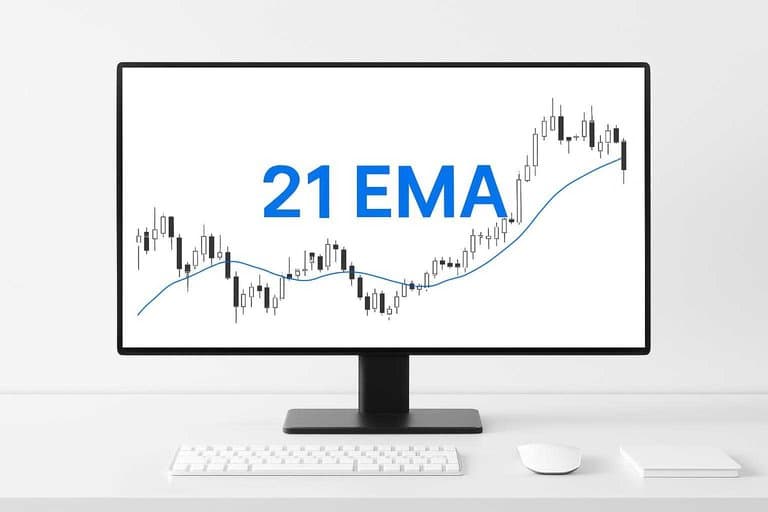
- Closes slip below the 21 EMA
- 50 DMA tests become frequent
- Reclaim rallies fade by the close
If support needs constant rescuing, demand is already gone.
Overhead Supply Zones
Choppy markets leave behind distribution pockets that act like invisible resistance. Price can look “set,” yet every rally runs into trapped holders.
Mark supply using:
- Left-side high-volume nodes that preceded a breakdown
- Prior breakdown levels where the stock “fell away” in days
- Wide-range down bars that started the base
- Areas with multiple closes that failed to hold above
If your pivot sits inside supply, the breakout is fighting history.
Base Quality Checklist
Run a fast audit before you treat the base as a launchpad. You want compression, then proof, then leadership.
- Count contractions and require fewer, tighter swings into the pivot.
- Confirm tight closes near highs, with volume drying on pullbacks.
- Validate leadership via new-high list participation, not just “up today.”
If it isn’t acting like a leader before the breakout, it won’t become one after.
Relative Strength Lies
Relative strength can look perfect while your stock goes nowhere. In chop, RS lines and rankings stay elevated because the benchmark is falling faster, not because your stock is trending. That’s how you buy a “leader” that behaves like a coin flip.
RS vs Price Divergence
Two RS/price patterns show up in chop, and both bait you into late entries. You see “RS at highs” or “tight action,” but the tape is mean-reverting.
Pattern A — RS rising while price stalls:
- Price chops sideways near highs
- Benchmark drops faster
- RS line rises anyway
Pattern B — RS flat while a breakout triggers:
- Price pops over a pivot
- Benchmark pops too
- RS barely moves
In both cases, RS stops being a leading signal and becomes a benchmark artifact.
Benchmark Distortion
In chop, your benchmark becomes a funhouse mirror. RS looks strong because the index behavior is weird, not because your stock is clean.
- Index whipsaws reset RS math daily
- Sector rotation lifts RS without trend
- Defensive leadership inflates “relative winners”
- Mega-cap drag makes midcaps look strong
If the benchmark is unstable, your RS readout is unstable too.
Cleaner RS Confirmation
You need RS rules that force alignment with price and time. Otherwise, you’re just ranking survivorship during a drawdown.
- RS is high before the pivot forms
- RS breaks out within days of price
- RS holds above entry for a week
- RS improves on pullbacks, not rallies
Treat RS as confirmation, not permission.
Bad Timing Entries
Choppy markets punish timing more than pattern quality. A clean Minervini-style setup can still fail if your entry ignores volatility and liquidity.
| Timing mistake | What it looks like | Fix | Risk impact |
|---|---|---|---|
| Early entry | Buy before pivot clears | Wait for close-through | Multiple small stop-outs |
| Late entry | Chase extended breakout | Use buy zone rules | Wide stop, poor R:R |
| Bad add-on | Add into stall candle | Add on strength only | Average up into pullback |
| Forced re-entry | Rebuy same day stop | Require reset + base | Emotional overtrading |
If your timing needs hope, you’re not trading a setup. You’re trading noise.
For a volatility reality check, compare moves using ATR percent (ATRP) so your entries and stops reflect the current regime rather than a “normal” tape.
Stops Hit Repeatedly
Choppy markets turn clean Minervini entries into stop-hunts, even when your thesis is right. You follow the rules, take small losses, then watch the stock drift higher without you. That’s not bad discipline. It’s regime mismatch.
Stop Placement Errors
In chop, your stop location matters more than your entry. Three common placements invite repeated churn because they sit where everyone expects.
- Place stops just under intraday noise
- Place stops under obvious prior lows
- Ignore ATR expansion on breakout days
If your stop is predictable or too small, you’re donating liquidity to the range.
Volatility-Scaled Stops
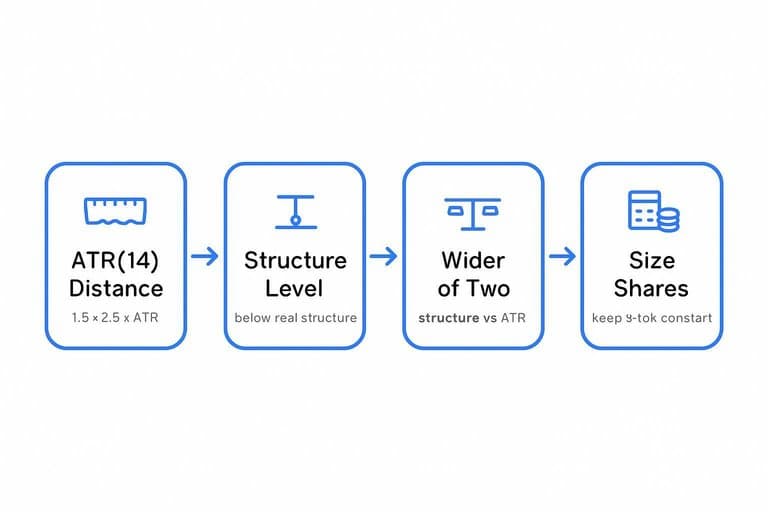
You want the stop to survive normal movement, not hope for perfect timing. Scale distance to volatility, then use sizing to keep dollars risked constant.
- Calculate ATR(14) and set distance at 1.5–2.5× ATR.
- Anchor the stop below a real structure level, not a round number.
- Use the wider of structure stop or ATR stop distance.
- Size shares so total $ risk matches your rule.
- Reduce size again if the market is below key MAs.
Wider stops don’t increase risk when sizing does its job.
Time Stops and Scratch Rules
Price stops fail when price drifts sideways and bleeds your focus. Add non-price exits that cut dead money before it becomes emotional.
Use rules like “no progress by day 5,” “close back into the base,” or “failed retest within two sessions.” That’s how you protect mental capital when the chart won’t commit.
Reduce Re-Entry Churn
Chop tricks you into the same trade three times in a week. You need a gate that forces fresh information before you try again.
- Re-enter only on a new pivot, not the old trigger.
- Require a market tailwind, like index reclaiming its 50-day.
- Cap attempts to two per symbol per base.
Your edge isn’t persistence. It’s selectivity under the right backdrop.
Market Context Ignored
Minervini-style breakouts are trend-following signals, not magic entry points. In a choppy tape, the “perfect” VCP can still fail because the market stops rewarding risk. You’re trading the stock, but you’re getting graded by the index.
Trend Template for Indexes
You need a fast gate that answers one question: is the index in a trend that pays breakouts. Run it on your main risk index, like QQQ or SPY.
- Price above rising 50DMA and 200DMA
- 20-day higher highs, higher lows
- Pullbacks lighter volume than advances
If two checks fail, you’re not “early.” You’re fighting the environment.
Liquidity and Rates
Chop is often a liquidity problem wearing a price chart mask. When financial conditions tighten, breakouts stop getting follow-through and start getting sold into.
Watch simple proxies and use hard pauses:
- 10Y yield: pause new buys above recent 3-month highs
- DXY: pause if trend is up 4+ weeks
- High-yield spreads (HYG vs IEF): pause if ratio breaks 50DMA
- Financial Conditions Index (GSFCI): pause on two-week rise
Treat these as a circuit breaker, not a prediction tool.
Rotation Risk Map
Rotation kills clean setups because leadership gets sold to fund new leadership. Your job is spotting “mixed leadership” weeks before your entries become donations.
- Rank sectors weekly by 4-week relative strength vs SPY.
- Flag leaders losing RS and breaking the 10-week line.
- Count sectors making new RS highs versus new RS lows.
- Avoid new buys when leaders weaken and breadth is split.
When money can’t commit to one leadership lane, your breakout edge disappears.
Fix: Chop-Proof Workflow
Use a workflow so you stop arguing with the tape and start filtering it. You want fewer “perfect” VCPs that instantly fail.
- Diagnose chop first: check index trend, 20/50-day slope, and ATR expansion.
- Filter candidates hard: require relative strength, tight closes, and clean volume dry-ups.
- Define entries precisely: buy only on breakouts with range expansion and real volume.
- Pre-plan exits: set invalidation under the last tight base, then honor it fast.
- Review weekly: tag every loss as “market chop” or “stock defect” and adjust rules.
If step one says chop, your best setup is often no trade.
Run the Chop-Proof Checklist Before You Take the Next Pivot
- Start with regime: confirm index trend + volatility/breadth aren’t screaming “range.” If they are, cut position size and require tighter filters.
- Grade the base: avoid late-stage structures, multiple failed pivots, and obvious overhead supply; only take clean bases with firm support.
- Demand fuel: look for volume/participation confirmation (or clear contraction-to-expansion behavior) before treating a breakout as real.
- Verify RS honestly: require RS strength and price progress vs the benchmark; skip names where RS “works” only because the index is falling.
- Enter and manage for chop: use volatility-scaled stops, add time stops/scratch rules, and limit re-entry attempts to prevent churn.
Frequently Asked Questions
Does the Mark Minervini strategy still work in 2026, or is it only effective in strong bull markets?
It still works, but it’s usually best in sustained uptrends with expanding liquidity. In choppy or range-bound markets, the same Minervini-style breakout triggers often need stricter filters and fewer attempts to avoid churn.
What are the best Mark Minervini-friendly markets or stock types to trade when conditions are choppy?
Liquid leaders with strong institutional sponsorship and clear catalysts often hold up best, especially in defensive growth areas. In chop, many traders do better focusing on A+ volume/volatility profiles and avoiding thin, news-driven small caps.
How can I backtest Mark Minervini setups to see if chop is the reason my results are poor?
Segment your backtest by market regime (uptrend vs chop) using an index filter like the S&P 500/QQQ above the 50/200-day moving averages and measure expectancy separately. Track breakout follow-through (e.g., +5% in 5–10 sessions) and stop-out rate to pinpoint regime-specific underperformance.
Can I use options with Mark Minervini setups to reduce losses in choppy markets?
Yes—many traders use defined-risk structures like debit spreads or smaller premium risk to cap downside when whipsaws are common. Keep position risk similar to your equity risk model (often 0.25%–1% of account per trade) and avoid illiquid chains with wide spreads.
How many failed Mark Minervini breakouts in a row is a red flag that the market is too choppy?
Often 3–5 failed breakouts or rapid stop-outs within 2–3 weeks is a strong warning that conditions aren’t supportive. When that happens, reduce exposure, tighten your “trade gate” criteria, or pause new entries until breadth and trend improve.
Chop-Proof Your Minervini Process
Minervini-style breakouts work best when leadership and breadth support them—without that context, chop turns clean setups into repeated stop-outs and late entries.
Open Swing Trading gives you daily RS rankings, breadth, and sector/theme rotation so you can filter for real leaders and avoid dead breakouts—get 7-day free access with no credit card.
Sources
- Net New 52-Week Highs — ChartSchool (StockCharts) — referenced in Base Quality Checklist
- Average True Range Percent (ATRP) — Fidelity Indicator Guide — referenced in Bad Timing Entries