
Why sector theme strength fails in choppy markets
A practical troubleshooting guide to why sector theme strength stops working in choppy markets—spot false breakouts, diagnose regime shifts and flow-driven whipsaws, confirm “chop” with simple checks, and apply tighter entries/exits plus broader evidence to decide when to trade or stand down.
Why sector theme strength fails in choppy markets
A practical troubleshooting guide to why sector theme strength stops working in choppy markets—spot false breakouts, diagnose regime shifts and flow-driven whipsaws, confirm “chop” with simple checks, and apply tighter entries/exits plus broader evidence to decide when to trade or stand down.
Your strongest sector theme can look perfect on paper—rising relative strength, clean narratives, even steady inflows—yet every entry turns into a quick stop-out. If that’s happening, the problem usually isn’t your stock selection. It’s the market’s texture.
This troubleshooter helps you recognize chop early, identify the specific failure mode breaking your theme signals, and adjust your process. You’ll get concrete steps to confirm conditions, tighten triggers and sizing, adapt exits for whipsaws, and know when the only winning move is to pause.
Choppy Market Symptoms
Chop is when price action punishes commitment. Breakouts fail, breakdowns snap back, and your “clean” sector theme turns into noise.
That’s why sector themes can look strong on paper yet lose money in practice. You get false confidence from strong rankings, then you get whipsawed when regimes shift under the surface.
False Breakout Signals
Chop advertises itself through repeatable tells. You see them before the theme P&L turns into a saw blade.
- Repeated breaches of the same key level
- Fast reversals within one to three sessions
- Smaller follow-through in prior leading sectors
If you need three confirmations, you’re not trending. You’re being baited.
Theme Metrics Mislead
Relative strength, breadth, and momentum can stay “green” while the tape deteriorates. A sector can rank well because it fell less, not because it’s being accumulated.
Watch for distribution days clustering, volatility expanding, and correlations rising across sectors. Those shifts make yesterday’s leaders behave like index proxies.
Your dashboard stays optimistic because it measures position, not intent. Price can be strong and still be for sale.
Capital Rotation Whipsaw
Rotation gets violent in chop because time horizons compress. Flows chase what just worked, then get forced out.
- Sector A breaks out and attracts “theme” inflows.
- Two days later, macro headline hits and Sector A reverses hard.
- Money rotates into Sector B, the prior laggard, for “safety.”
- Sector A rebounds as shorts cover and dip-buyers return.
- Sector B rolls over when the defensive bid fades.
The pain isn’t picking the wrong theme. It’s entering a market that refuses to pay trend followers.
Root Cause Diagnosis
Correlation Regime Shift
Choppy markets flip correlation math on you. Diversifiers suddenly move together, and your “sector view” starts tracking the index.
In risk-off or fast mean-reversion tape, cross-asset correlations rise and intra-sector dispersion falls. That turns a clean relative bet into a beta bet, where the macro shock dominates every earnings nuance. You feel it when every chart prints the same V and your “idiosyncratic” winner behaves like SPY.
That’s the line that gets crossed: your thesis is fine, but the regime makes it irrelevant. (See evidence on cross-correlations increasing during stress.)
Volatility Compression Trap
Low volatility flatters almost any trend signal. Your theme looks “strong” because price moves are smooth and stops sit close.
Then volatility expands and the same stop distance becomes noise-sized. Stop-outs cluster, re-entries get whipsawed, and the signal-to-noise ratio collapses because the path matters more than the destination. You’ll see good news still lead to red candles, simply from positioning resets.
Fix the risk geometry first. Signals are easy.
Liquidity And Flows
When volatility rises, flows outrank fundamentals in the short run. You’re trading plumbing, not stories.
- ETF rebalancing forces mechanical sector buying and selling
- Options hedging creates gamma-driven chase and snapback
- Systematic de-risking sells winners to cut gross exposure
- Risk-parity deleveraging hits anything with rising realized vol
- CTA trend flips accelerate exits after level breaks
If flows are the marginal buyer, your “theme strength” is just temporary order imbalance.
Timeframe Mismatch
Most theme work is medium-term, but chop is microstructure-driven. You need your holding period to match the market’s mean-reversion speed.
- Define your catalyst window in dates, not narratives.
- Identify the positioning cycle from surveys, flows, and options.
- Estimate mean-reversion speed using ATR and reversion half-life.
- Set stop and take-profit to that reversion, not your conviction.
- Recheck after volatility regime changes or macro prints.
When your horizon is wrong, you don’t lose on thesis. You lose on timing.
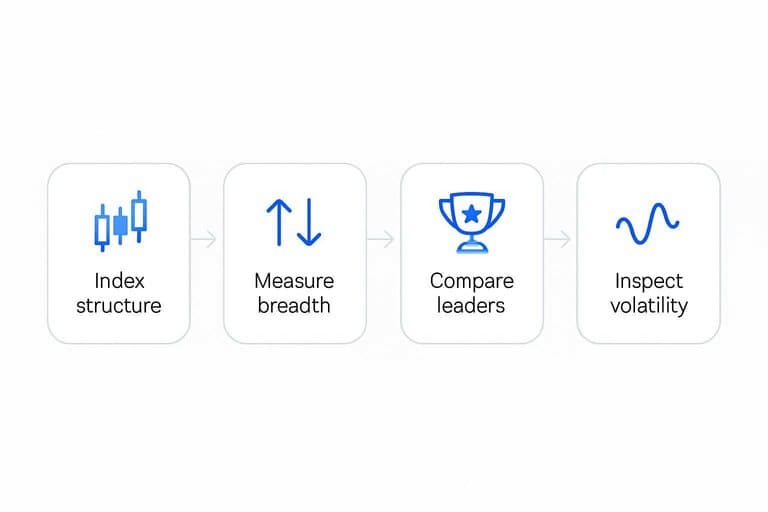
Confirm It’s Chop
Choppy markets punish sector-theme signals because follow-through dies fast. Run this quick diagnostic before you trust any “rotation” headline.
- Check index structure: higher highs and higher lows, or overlapping candles.
- Measure breadth: advancing issues vs declining issues for five sessions.
- Compare leaders: top sectors change weekly, or persist for a month.
- Inspect volatility: VIX rising with flat price, or falling with trend.
- Time your breakouts: three-day follow-through, or same-week reversal.
If two or more checks scream “overlap,” treat sector strength as noise, not narrative.
Failure Mode Matrix
Choppy markets break clean sector stories. Use this matrix to diagnose what you’re seeing, then test the quickest fix.
| Symptom | Likely root cause | Fastest test next | Expected tell |
|---|---|---|---|
| Leaders flip daily | Rotation too fast | Shorten lookback | Fewer whipsaws |
| Strong theme, weak P&L | Crowded positioning | Add crowding filter | Lower correlation spikes |
| Breakouts fail quickly | Volatility expansion | Use ATR stops | Smaller loss tails |
| All sectors move together | Macro dominates | Add regime switch | Fewer false signals |
| Signals lag news | Data latency | Use faster inputs | Earlier entries |
Treat this like triage, not theory—run the fastest test first and measure within a week.
Fix: Tighten Entries
Sector themes can be right while your entry is wrong. In chop, the theme pays later, but the entry bleeds you first.
Think “good thesis, bad timing.” Fix the structure, not the story.
Trade Less, Filter More
In choppy tape, your edge comes from saying “no” more often. You want fewer trades, but cleaner ones.
- Require weekly trend aligned with daily setup
- Skip entries when ATR is below threshold
- Demand close above level, not a wick
- Confirm with $IWM or $HYG strength
- Avoid sector leaders underperforming $SPY
If you can’t filter it, you can’t size it.
Trigger Redefinition
Intraday breaks lie most when ranges are tight. Change what counts as “in” so noise stops choosing for you.
Use a daily close beyond your level, not a 10-minute spike. Prefer the breakout close, then a retest hold, or a volatility-adjusted breakout like “close > level + 0.5x ATR.”
Your trigger should make price prove it, not hint at it.
Position Sizing Rules
Sizing has to adapt to volatility, or chop will churn you to death. Build a sizing rule you can run in 30 seconds.
- Set a fixed risk unit per trade, like 0.5% of equity.
- Measure ATR(14) or 20-day realized vol for the ticker.
- Set stop distance as a multiple of ATR, then compute shares from risk.
- Scale down exposure when sector vol rises above your baseline.
- Cap sector concentration, like 2–3 positions or 20% gross.
If your size doesn’t shrink in chop, your “strategy” is just pain tolerance.
Fix: Adapt Exits
Choppy tape punishes “hold for the theme” thinking. Your exit rules need to assume reversals, not trends, so winners pay for losers.
Bracket For Chop
In mean reversion, your edge is capture speed, not prediction. You want exits that harvest the first clean push, then get small fast.
Use a simple bracket that changes by context:
- Time stop: Exit if no follow-through after 3–5 bars or 1–2 days.
- Tighter target: Take profit at 0.8–1.2R near prior range midline.
- Partials: Sell 1/3 at 0.5R, trail the rest tight.
- Runner rule: Keep 10–20% only if range breaks.
If you need “one more day,” you’re already late.
Stop Placement Errors
Most chop losses aren’t bad entries. They’re lazy stops that invite noise.
- Parking stops at obvious swing lows
- Using identical stop distances across sectors
- Ignoring event gaps on CPI, FOMC, earnings
- Placing stops inside the day’s noise band
- Moving stops wider after a red candle
Fix the stop logic first, and your theme strength starts showing up again. (For background on vol-based risk proxies, see what VIX measures.)
Re-entry Protocol
Re-entry is how you turn chop into a second chance, not revenge. You need a rule that forces calm conditions.
- Wait for volatility to compress for 1–3 sessions.
- Require price to reclaim your key level intraday.
- Confirm with breadth improving versus the sector ETF.
- Add only after volume expands on the reclaim.
- Reset risk to the original stop plan.
A clean re-entry beats a stubborn hold, almost every time.
Fix: Broaden Evidence
Sector “strength” fails fastest when a few mega-caps drag the whole chart higher. You want multiple, independent confirmations so your theme isn’t just a thin rally in disguise.
Internal Breadth Checks
Choppy tape rewards real participation, not headline winners. Use breadth to test whether leadership is wide and repeatable.
- Track sector advancers vs decliners
- Compare equal-weight vs cap-weight returns
- Count new highs vs new lows
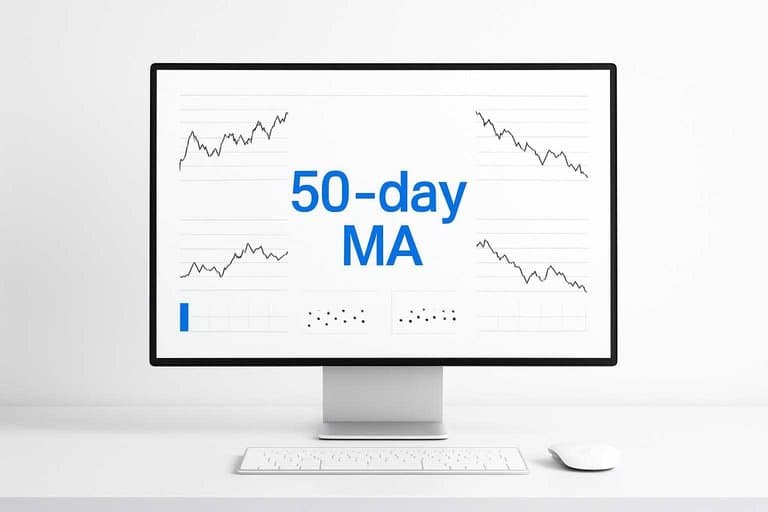
- Monitor % above 50-day MA
- Check median stock relative strength
If two or more disagree, your “leader” is probably one stock.
Factor And Macro Exposure
A sector is rarely a pure theme in a choppy market. It’s usually a bundle of factor bets wearing a sector label.
Break the sector into exposures like value, quality, momentum, and size. Add macro sensitivities like rates duration, oil beta, USD beta, and credit spreads. Then ask one blunt question: did the sector move, or did its biggest exposure move. That’s the line between “theme working” and “factor bounce.”
Pairing And Hedges
Pairs and hedges keep you trading the idea, not the market. They also force you to define what “strong” and “weak” really mean.
- Go long the strongest industry group inside the sector.
- Short a weaker peer group or sector ETF.
- Add an index hedge to neutralize market swings.
- Size legs to target low net beta.
- Rebalance when betas drift.
If you can’t neutralize beta, you’re not running a theme trade yet.
When To Stand Down
You need a clean checklist for when “do nothing” beats forcing a sector theme. Use these conditions as hard brakes, not vibes.
| Do nothing condition | What you’ll see | Quick check | Recommended action |
|---|---|---|---|
| Volatility spike | Range widens fast | VIX up 15%+ | Cut size, wait 24–48h |
| Macro event risk | Headlines drive tape | CPI/Fed within 48h | Stay flat, set alerts |
| Correlation surge | Everything moves together | Avg corr > 0.70 | Trade index, not sectors |
| Failed retest count | Breakouts won’t hold | 2 failed retests | Stop entries, reassess thesis |
| Liquidity air pockets | Slippage jumps | Spreads double | Use limits, or skip |
If you hit two conditions at once, you’re not early—you’re just in the chop.
Resolution Playbook
Choppy markets break theme signals because leadership rotates faster than your model can adapt. Use this sequence to diagnose the failure, apply targeted fixes, and confirm the edge returned.
- Tag the regime: high dispersion, low trend, frequent leader swaps.
- Decompose returns: beta, sector tilt, industry tilt, single-name impact.
- Stress the signal: shorten windows, add decay, test delay and slippage.
- Add guardrails: volatility scaling, trend filter, max turnover, stop rules.
- Re-validate: walk-forward tests, out-of-sample weeks, live paper checkpoint.
Treat chop like a different product, not a temporary bug.
Turn Theme Strength Into a Tradeable Plan
- Diagnose the regime: confirm chop, then name the dominant failure mode (false breakouts, metric mirage, or rotation whipsaw).
- Tighten entries: reduce frequency, add filters, redefine triggers to require follow-through, and size for wider noise.
- Adapt exits: use brackets built for chop, fix stop placement errors, and predefine re-entry rules so you don’t revenge-trade.
- Broaden evidence: validate with breadth, factor/macro exposure, and pairs/hedges to separate “theme” from “tape.”
- Stand down when signals disagree: if multiple checks conflict or stops cluster repeatedly, pause and wait for expansion and trend reassertion.
Frequently Asked Questions
Does sector theme strength still work in 2026, or is it obsolete in volatile markets?
Sector theme strength still works, but it performs best when dispersion is high and cross-asset correlations are stable. In choppy, volatility-driven regimes, themes often lag because index-level flows and hedging dominate relative performance.
How do I measure sector theme strength objectively (not just by price charts)?
Track relative strength vs a benchmark (e.g., XLK/SPY), plus breadth and leadership metrics like % above the 50-day MA, advance/decline within the sector, and top-10 weight contribution. Most traders validate with a risk-adjusted lens such as RS rate-of-change + ATR or a 20–60 day information ratio.
What results should I expect when trading sector theme strength—how often should it be right?
In trend-friendly regimes, a solid theme often shows follow-through within 1–3 weeks and should outperform the benchmark over a 1–3 month window. In chop, expect lower win rates and smaller average gains unless you reduce holding time and demand stronger confirmation.
Can I use sector theme strength with ETFs instead of picking individual stocks?
Yes—sector ETFs (e.g., XLF, XLE) often reduce idiosyncratic risk and make theme execution cleaner. The trade-off is less upside versus best-in-breed leaders, so many use ETFs for exposure and a small basket of leaders for alpha.
How often should I update sector theme strength rankings and rotate—daily, weekly, or monthly?
Weekly updates work best for most swing traders because sector leadership usually shifts on multi-week cycles. Daily ranking changes are often noise in choppy markets, while monthly reviews can be too slow to catch leadership transitions.
Trade Themes With Context
In choppy tape, sector theme strength can look convincing right before it fails. Turning your failure-mode checks into a daily routine is what keeps you aligned with the real regime.
Open Swing Trading streamlines that routine with daily RS rankings, breadth, and sector/theme rotation views so you can spot true leaders faster—get 7-day free access with no credit card.
Sources
- Changes in Cross-Correlations as an Indicator for Systemic Risk (Scientific Reports, 2012) — referenced in Correlation Regime Shift
- VIX Intro / What Is VIX and What Does it Measure? (S&P Dow Jones Indices) — referenced in Stop Placement Errors