Why Your “Better Stock” Picks Lag by 20%
A practical troubleshooter for diagnosing why your “better stock” picks still trail by 20%—verify lag symptoms and benchmarks, uncover hidden return leakages, separate thesis quality from price action, detect factor-exposure drift, and fix portfolio-construction and process errors with clear checklists and tables.
Why Your “Better Stock” Picks Lag by 20%
A practical troubleshooter for diagnosing why your “better stock” picks still trail by 20%—verify lag symptoms and benchmarks, uncover hidden return leakages, separate thesis quality from price action, detect factor-exposure drift, and fix portfolio-construction and process errors with clear checklists and tables.
If your “best ideas” keep lagging the index by 20%, it’s tempting to blame bad luck—or the market being irrational. More often, the underperformance is coming from something measurable: the wrong benchmark, quiet fees and taxes, factor drift, or a thesis that never had a realistic path to re-rating.
This troubleshooter walks you through fast diagnostics and common failure modes so you can pinpoint what’s actually dragging returns, then tighten your portfolio construction and decision process before the next set of picks repeats the same pattern.
Lag Symptoms
A “20% lag” is a gap between your portfolio’s return and a benchmark over the same window. It often hides a mismatch: your “better stocks” are judged against a yardstick they were never built to beat, like comparing a dividend portfolio to the Nasdaq. Treat one-off noise differently from a repeating shortfall, or you’ll fix the wrong problem.
Confirm the math
Make the measurement boring and exact before you diagnose anything.
- Use total return, not price, and include reinvested dividends.
- Adjust for splits, spin-offs, and special dividends.
- Match currency exposure for both portfolio and benchmark.
- Subtract fees, spreads, and taxes you actually paid.
- Lock the same start and end timestamps.
If your “20% lag” shrinks after this, it was accounting, not investing.
Pick the benchmark
A benchmark is a claim about what you were trying to do.
- Use a market index for broad beta exposure.
- Use a sector index for concentrated industry bets.
- Use a factor index for value, quality, or momentum tilts.
- Use a blended benchmark for intentional mixes.
- Use cash or bonds for capital-preservation goals.
Pick the wrong yardstick and you’ll “underperform” by definition.
Is it persistent?
A 20% gap over one window can be a timing artifact, not a durable edge or flaw. Check rolling 3-, 6-, and 12-month returns versus the benchmark, and separate relative drawdowns from long-run drift. A few ugly months, like a sharp rate spike, can create a headline gap that later mean-reverts.
Identify the pattern
Tie the lag to specific drivers, not vibes.
- Mark dates of major relative underperformance.
- Tag each date to earnings, guidance, or revisions.
- Check valuation change: multiple expansion or compression.
- Overlay sector and factor rotation for the same weeks.
- Flag any single-stock blowup and its weight.
When you can name the driver, you can choose whether to endure it or exit it.
Hidden Return Leakages
Most “better stock” picks underperform because returns leak outside the thesis. You can spot the leaks fast if you track them like bugs, not feelings.
Here are the usual culprits, how to detect them, and the fastest fix.
| Leakage | What it looks like | How to detect | Fastest fix |
|---|---|---|---|
| Fees and spreads | Small losses daily | Compare to fee-free index | Use cheaper, liquid ETFs |
| Taxes and turnover | Wins, weak net | Track after-tax returns | Hold longer, tax-loss harvest |
| Sizing errors | Big ideas, tiny impact | Attribution by position | Set sizing rules upfront |
| Timing slippage | Right call, wrong day | Limit vs market fills | Use limits, stage entries |
| Benchmark mismatch | “Lagging” by design | Style-box your holdings | Pick a true benchmark |
If you can’t name the leak, you can’t fix it.
Most “better stock” picks underperform because returns leak outside the thesis. You can spot the leaks fast if you track them like bugs, not feelings.
Here are the usual culprits, how to detect them, and the fastest fix.
| Leakage | What it looks like | How to detect | Fastest fix |
|---|---|---|---|
| Fees and spreads | Small losses daily | Compare to fee-free index | Use cheaper, liquid ETFs |
| Taxes and turnover | Wins, weak net | Track after-tax returns | Hold longer, tax-loss harvest |
| Sizing errors | Big ideas, tiny impact | Attribution by position | Set sizing rules upfront |
| Timing slippage | Right call, wrong day | Limit vs market fills | Use limits, stage entries |
| Benchmark mismatch | “Lagging” by design | Style-box your holdings | Pick a true benchmark |
If you can’t name the leak, you can’t fix it.
For more on how trading frictions like bid-ask spreads reduce returns, see the SEC’s overview on bid-ask spreads for ETFs.
Thesis vs Price
You can be right about the business and still lose on the stock. Price follows what the market is paying for, not what you admire.
Multiple compression
Great earnings can rise while your stock falls. The market just decides to pay less for each dollar.
Watch three trendlines, not one:
- P/E vs earnings growth
- EV/EBITDA vs EBITDA growth
- FCF yield vs FCF growth
If earnings are up but P/E and EV/EBITDA slide, your “better stock” is getting de-rated.
Expectations too high
Sometimes the stock already priced your thesis in. You’re holding “good news” that no longer surprises.
- Peak margins already printed
- Guidance reads like a script
- Ownership looks crowded
- Revisions stop moving up
When expectations are perfect, the only catalyst left is imperfection.
Catalyst missing
Some stories are eventless. The company compounds, but the stock waits.
Look for a forcing function:
- A re-rating trigger, like lower rates
- A buyback that tightens float
- A spin-off that reveals value
- An inflection in growth or margins
Without a clock, “eventually” becomes “never” in your portfolio.
Narrative regime shift
Narratives rotate, and your stock can become irrelevant overnight. Check the tape’s obsession before you check your model.
- Name the dominant narrative driving flows this quarter.
- Map it to factors: duration, value, cyclicals, quality, momentum.
- Score your stock’s fit: beneficiary, neutral, or victim.
- Identify the disconfirming data that would flip the narrative.
- Set a time-box to re-evaluate if nothing changes.
If your thesis needs one regime and you’re in another, you’re early by definition.
Factor Exposure Drift
Your “quality” screen can still buy a portfolio that behaves like something else. A clean balance sheet can come bundled with long-duration growth, small-cap risk, or momentum. Then you wonder why your “better stocks” move like a crowded trade.
Run a factor check
You can’t manage what you don’t measure, and factor drift is usually invisible in single-name analysis.
- Pull style box, market cap, and sector weights for your holdings.
- Compare portfolio beta and volatility versus your benchmark.
- Check profitability, leverage, and investment factors against the benchmark.
- Add duration proxies like P/E, sales growth, and rate sensitivity.
- Review momentum and drawdown metrics over 3–12 months.
If your “quality” basket matches the benchmark except for two big tilts, those tilts own the outcome.
If you need a clear map of common factors, MSCI’s primer on equity factors like quality and momentum is a useful reference.
Crowding and unwinds
Crowded factors work until they don’t, and the break is fast. One day your “high-quality” names all gap down together on the same headline.
That’s usually an unwind, not a fundamentals surprise. When everyone owns the same factor bundle, selling becomes synchronized and correlations jump.
Momentum trap signals
Momentum can sneak into “quality” when you buy what recently worked. You need simple tells that your screen is chasing heat.
- Late-cycle breakouts after long runs
- Vertical charts with thin pullbacks
- Weak breadth under the index
- Falling relative strength versus benchmark
If three show up at once, you’re buying a factor, not a business.
Rebalance exposures
Neutralizing drift is portfolio work, not a new stock idea.
- Add diversifiers that benefit from opposite macro regimes.
- Cap position sizes in the most factor-loaded names.
- Pair with opposite factors, like value or low-volatility.
- Stagger entries to avoid buying the same impulse.
Fix the exposure mix first, and your “quality” process gets a fair test.
Portfolio Construction Failures
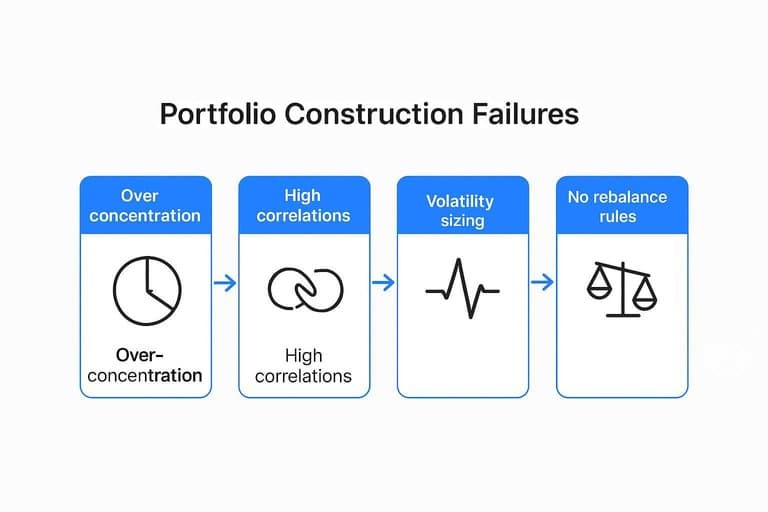
Good picks can still lose to a boring index because your portfolio math is quietly fighting you. The gap shows up when you concentrate, double up on the same factor, or size positions by conviction instead of risk.
A 20% lag often isn’t “bad stocks.” It’s construction.
A quick way to spot it is to map the failure mode to the performance leak.
| Construction error | What it looks like | Hidden effect | Typical drag |
|---|---|---|---|
| Over-concentration | One name dominates | One mistake rules | -5% to -15% |
| High correlations | “Diversified” same sector | Fewer real bets | -3% to -10% |
| Volatility sizing | Biggest = wildest | Risk clusters | -2% to -8% |
| No rebalance rules | Winners drift up | Buy high bias | -2% to -7% |
| Cash timing | Waiting “for clarity” | Missed rebounds | -2% to -6% |
If you see two or more of these together, your stock picks never got a fair shot.
Process Errors Checklist
Your picks can be right and still underperform because your process leaks edge at the seams. The goal here is to spot repeatable mistakes—timing, information, and rule-breaking—that shave 20% without you noticing.
Entry timing errors
You usually overpay when you wait for “proof,” like buying only after a glowing earnings call. That’s confirmation-chasing, and it prices in the good news before you own it.
Use hard rules that force you to buy when risk is defined, not when sentiment peaks:
- Predefine a buy zone, like “prior base highs ±2%.”
- Require volume confirmation, not narrative confirmation.
- Set a max price, then walk away if it gaps above.
- Split entries, like 50/30/20, across your zone.
If your trigger is “everyone agrees now,” you’re paying for agreement.
Sell discipline gaps
Most underperformance is a sell problem disguised as a stock problem. You need exit rules that fire even when you still “like the company.”
- Exit when the thesis breaks, not when the price hurts.
- Use a time stop, like “no progress in 12 weeks.”
- Trail a stop after strength, like “below 20-day low.”
- Trim into spikes, like “sell 1/3 at +25%.”
- Tag dead money, then reallocate on a fixed schedule.
You don’t get paid for loyalty; you get paid for recycling capital.
Research blind spots
Your research feels thorough until you check what actually moves long-run returns. These blind spots quietly turn “better stock” into “worse outcome.”
- Ignore unit economics under scale.
- Miss working capital cash drains.
- Underestimate dilution and SBC.
- Assume competitors won’t respond.
- Misread incentives and pay plans.
If you don’t model the downside, you’re just collecting reasons.
Decision journaling loop
You can’t fix what you don’t capture, and memory edits the tape. A journal turns vague “I knew it” into specific pattern removal.
- Write the thesis in one paragraph, plus the disconfirming signal.
- Do a pre-mortem: list three ways you’re wrong.
- Define 3–5 key metrics and exact check dates.
- Review on a cadence, like weekly and post-earnings.
- Run a post-trade audit and tag the real error.
Your edge compounds when your mistakes stop repeating.
Run the 20% Lag Triage in One Hour
- Validate the lag: Recalculate total return (dividends, splits, cash flows), choose the correct benchmark, and confirm whether underperformance is persistent or clustered.
- Plug the leaks: Quantify taxes, fees, slippage, FX, and cash drag; fix the biggest dollar drain before debating stock narratives.
- Separate thesis from price: Decide whether you’re facing multiple compression, over-optimistic expectations, a missing catalyst, or a regime shift—and set a time/trigger-based reassessment.
- Check factor and construction: Run a factor exposure check, look for crowding/momentum traps, then rebalance exposures and position sizing so one hidden bet isn’t deciding outcomes.
- Lock in process upgrades: Add a pre-trade checklist, explicit sell rules, and a decision journal with scheduled post-mortems—so next quarter’s results improve by design, not hope.
Frequently Asked Questions
Does a “better stock” pick still matter in 2026 with ETFs and AI-driven markets?
Yes—single-stock selection can still add value, but only if your edge survives fees, taxes, and factor tilts that ETFs already deliver cheaply. Most “better stock” underperformance comes from implementation and exposures, not from the company being bad.
How do I measure whether my better stock picks are actually adding alpha (not just taking more risk)?
Compare your picks to a proper factor-adjusted benchmark (e.g., CAPM + Fama-French 5 factors, or a quality/value/growth factor model) and track rolling 12–36 month alpha. Tools like Portfolio Visualizer, Koyfin, or Bloomberg can run factor regressions and show whether returns are explained by hidden exposures.
What are realistic results to expect if I’m truly good at picking better stocks?
A strong stock-picker often targets roughly 1–3% annualized alpha after costs over a full market cycle, not immediate outperformance every quarter. If you’re down ~20% versus a benchmark over 12–24 months, that’s usually a signal of systematic issues rather than normal noise.
Can taxes and trading costs alone make a “better stock” portfolio lag by 20%?
Yes—high turnover plus short-term gains can create a large performance gap, especially in taxable accounts, even when your gross picks are fine. Check after-tax returns, turnover, and realized gain reports to see if drag is coming from friction rather than stock selection.
If I don’t have time for deep research, what’s a good alternative to “better stock” picking?
Use low-cost factor ETFs (quality, value, momentum) or a diversified core index plus a small “satellite” stock-picking sleeve capped at 5–20% of the portfolio. This keeps your base returns market-like while you test whether your better stock process truly adds value.
Turn Better Stocks Into Leaders
Diagnosing lag is the easy part—preventing hidden leakages, factor drift, and portfolio construction mistakes requires a repeatable, daily selection workflow.
Open Swing Trading helps you surface true breakout leaders with daily RS rankings, breadth, and sector/theme rotation context—then build cleaner watchlists in minutes. Get 7-day free access with no credit card.
Sources
- SEC — Investment Company/ETF guide (Mutual Funds and ETFs) (sec-guide-to-mutual-funds.pdf) — referenced in Hidden Return Leakages
- MSCI — Factor Indexes overview — referenced in Run a factor check