Why your market breadth dashboard gives false risk signals
A practical troubleshooter for market breadth dashboards that throw off false risk signals—validate your universe and timestamps, fix A/D line and volume-breadth math, de-mirage 52‑week highs, and rebuild moving averages and thresholds so indicators match reality.
Why your market breadth dashboard gives false risk signals
A practical troubleshooter for market breadth dashboards that throw off false risk signals—validate your universe and timestamps, fix A/D line and volume-breadth math, de-mirage 52‑week highs, and rebuild moving averages and thresholds so indicators match reality.
Your breadth dashboard flashes “risk-off,” but price action looks fine—and a week later you realize it was a data artifact, not a regime shift. That’s expensive: it drives premature de-risking, needless hedges, and whipsaw trades.
This troubleshooter helps you isolate the most common failure modes fast. You’ll learn where false signals creep in (universe drift, corporate actions, A/D line handling, volume distortions, 52-week window mistakes, and MA construction errors) and how to confirm the fix with simple sanity checks.
Verify Your Inputs
Breadth dashboards fail quietly when the inputs drift. Before you trust a “risk-off” spike, validate what you’re actually measuring.
Example: a sudden collapse in advance/decline can be one bad exchange filter, not a regime change.
Universe drift
Your breadth ratios are only as stable as your universe definition. Constituents change, and your dashboard rarely tells you when.
- Check delistings still represented in history
- Check new listings included after IPO date
- Check symbol changes mapped correctly
- Check constituents not frozen in time
- Check exchange filters match universe spec
If three checks fail, you’re reading data plumbing, not market risk.
Timezone mismatches
Mixed close times create phantom divergences across regions and venues. You need one canonical “day” and rules that enforce it.
- Pick a canonical session close, like 16:00 New York.
- Convert all timestamps into one timezone before any join.
- Resample to session bars using that close, not calendar midnight.
- Drop or shift prints that land outside the session window.
- Recompute breadth on the resampled bars only.
If your signal vanishes after resampling, the risk was just clock drift.
Corporate actions leakage
Splits and dividends rewrite the price path, and breadth math is hypersensitive to that. One unadjusted split can look like a 50% crash.
Example: a 2-for-1 split halves the raw price, so your “new lows” and moving averages flip instantly.
Adjustments must be consistent across price, returns, and indicators, or you’ll manufacture sell signals.
Survivorship bias
Backfilled universes hide the losers, then your dashboard looks calm in every crisis. You need point-in-time membership, not today’s roster.
- Pull index membership with effective start and end dates.
- Rebuild breadth daily using only members active that day.
- Compare results to your current “static” universe output.
- Run a dead-ticker audit: list symbols with no prints after delisting.
- Count how many dead tickers still influence your indicators.
If dead tickers never appear, your history is cleaned into fiction.
A/D Line Lies
Your A/D line can scream “risk-off” even when your market isn’t breaking. The usual culprit is plumbing: unchanged rules, duplicate symbols, or bad netting that flips signs.
Unchanged handling
Most A/D feeds hide a rule for “unchanged” names, and that rule quietly moves your baseline. One desk treats unchanged as “skip it,” another forces a side, and your spikes appear on stress days.
Three common rules:
- Ignore unchanged: A/D reflects only movers; baseline drifts with volatility.
- Count as advance: A/D lifts on flat tape; selloffs look less broad.
- Count as decline: A/D sinks on flat tape; stress looks worse.
Pick one rule, then pin it to a test so your baseline stops moving under you.
Multi-share duplicates
If your universe has duplicates, your A/D isn’t “breadth.” It’s “how many ways one issuer can show up.”
- Dual listings count the same company twice.
- Multiple share classes overweight the same issuer.
- Primary plus ADR doubles exposure.
- ETFs in the universe repackage the same constituents.
- Venue-level symbols fragment one security into many.
If mega issuers appear three times, your breadth becomes a popularity contest.
Netting mistakes
Recompute A/D from raw closes to find where your logic breaks. Don’t trust a vendor total until your signs match.
- Pull prior close and close for every symbol, same timestamp rule.
- Compute return sign: up, down, unchanged, with an explicit zero threshold.
- Apply your unchanged policy once, and log counts by bucket.
- Sum advances minus declines, then compare to your stored A/D.
- Reconcile deltas by symbol, then by venue and corporate action flags.
When your A/D doesn’t reconcile at the symbol level, the dashboard is doing math theater.
Volume Breadth Traps
Volume-weighted breadth looks “objective” because it uses shares, not votes. But volume is a venue artifact now, not a pure demand signal.
Dark pools, off-exchange prints, and auction bursts can flip your dashboard to red without real risk. If you don’t separate the plumbing from the tape, you’ll trade microstructure noise.
Auction spikes
Open and close auctions concentrate prints for reasons that have nothing to do with intraday stress. Index funds, MOC orders, and rebalance flows can swamp your breadth totals in minutes.
- Tag auction windows using your exchange calendar and official auction timestamps.
- Compute volume breadth for regular session only, excluding auction prints.
- Compute full-day volume breadth, then cap per-name volume at a percentile threshold.
- Compare regular-session vs full-day spreads and flag large divergences.
- Store auction share of volume as a separate risk factor.
If auctions drive the signal, your “risk” is timing, not liquidation. For more detail on how these prints cluster, see this NYSE closing auction guide.
Off-exchange distortion
Consolidated volume includes off-exchange trades, internalization, and delayed prints. Lit volume reflects displayed interaction, which is closer to real-time price discovery.
You’ll see “selling pressure” when off-exchange share jumps, even if lit markets are calm. That’s a venue mix shift, not a regime change.
ETF volume pollution
ETF prints are huge and mechanically driven, so they can hijack volume breadth. Creation and redemption flows can look like distribution, even when constituents are stable.
- Many top-volume tickers are ETFs
- Breadth flips on rebalance days
- Volume spikes without price spread widening
- Sector “risk” tracks one ETF
- Constituents look normal, ETF screams
Fix your universe first, or you’ll measure wrapper mechanics.
52-Week High Mirage
Your 52-week high/low widget looks simple, but it’s a minefield. One bad window, one adjusted print, or one short history can scream “risk” when nothing changed. You’ve seen it: “new highs collapsing” right after a holiday week or a rebalance.
Window definition errors
Use trading days, not calendar days, or your highs/lows drift every long weekend.
- Define the window as the last 252 trading sessions per ticker.
- Build sessions from an exchange calendar, including holidays and half-days.
- Roll by session index, not timestamp, to avoid calendar-day gaps.
- Assert window length equals 252 before classifying any high/low.
- Log exceptions: halted names, missing bars, or vendor outages.
If your window isn’t session-perfect, your “52-week” signal is fiction.
Insufficient history
New listings and recently reconstituted symbols hit “52-week highs” because they only have 30 or 90 days. That turns your breadth line into an IPO counter, not a risk gauge. Treat eligibility as a first-class state.
Set a minimum lookback, like 252 sessions, before a name can qualify. Until then, mark it “not eligible” and exclude it from the denominator. That one rule stops brand-new names from manufacturing strength.
Split-adjustment flips
Splits and retroactive adjustments can rewrite yesterday’s range. Run fast checks so “new lows” aren’t just data math.
- Compare adjusted vs unadjusted close on signal days.
- Flag price jumps near exact ratios, like 2:1 or 3:2.
- Detect vendor backfills that change prior bars overnight.
- Recompute highs/lows after corporate action events.
- Track symbol changes and share-class merges.
If the classification changes without real trading, you’re auditing data, not risk.
MAs Built Wrong
Breadth built from “% above 50/200DMA” fails when your moving averages and prices aren’t comparable. One ticker uses EMA, another uses SMA, and your “signal” becomes a vendor artifact. You end up reacting to math choices, not market risk.
SMA vs EMA mismatch
SMA and EMA cross at different times because they weight history differently. If your universe mixes methods, your breadth line becomes a timing quilt.
A few rules that keep it clean:
- Pick one MA type for all tickers.
- Recompute from raw closes across full history.
- Align lookbacks and warm-up periods.
- Version the formula, then never drift.
If two tickers “disagree” only due to MA type, you’re measuring tooling, not trend.
Stale prints
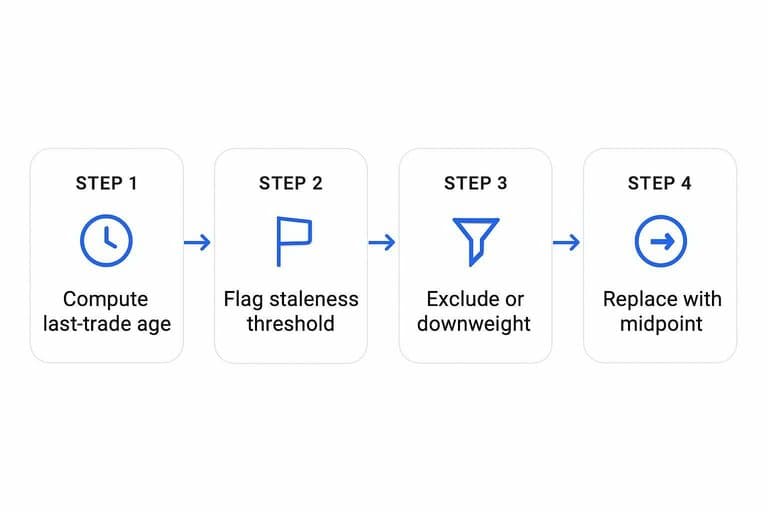
Illiquid names can hold a last price for hours or days, so their “above MA” flag lies. Detect staleness first, then decide how to price it.
- Compute last-trade age at each timestamp.
- Flag names above a threshold, like 30–120 minutes.
- Exclude flagged names from breadth, or downweight them.
- Replace stale last with midpoint when a valid quote exists.
- Log counts by day, then alert on spikes.
A single stale cluster can fake a “breadth collapse” on a calm tape.
Holiday gaps
Calendar gaps and exchange holidays create missing bars that your MA code must handle. The wrong rule can push many names below their MAs at once.
- Forward-fill closes across gaps.
- Skip missing sessions entirely.
- Interpolate prices across the gap.
- Rebase MAs only on trading days.
If your breadth plunges on a holiday, it’s your gap rule talking.
Thresholds That Whipsaw
Fixed breadth thresholds feel objective, so teams bake them into dashboards and alerts. But they often trigger fake “risk-on/off” flips when the market regime shifts.
A quick comparison helps you choose the least-wrong trigger for your use case.
| Threshold type | How it’s set | Common false flips | Best used when |
|---|---|---|---|
| Fixed level | e.g., 60/40 | Volatility regime change | Stable market structure |
| Fixed z-score | e.g., -2σ | Volatility compression | Consistent variance |
| Percentile | e.g., 10th/90th | Low dispersion periods | Regime varies often |
| Rolling percentile | e.g., 1y window | Window edge effects | Tactical monitoring |
| Hybrid (level + percentile) | both gates | Fewer, later flips | Alerts must be trusted |
If your dashboard flips often without price trend damage, your thresholds are the problem, not the market.
Lock in a Reliable Breadth Signal Before You Trade It
- Re-run today’s dashboard with a frozen universe snapshot, a single timezone standard, and fully adjusted corporate actions; confirm you can reproduce yesterday’s values.
- Audit the A/D line with edge cases (unchanged closes, multi-share classes, symbol changes) and reconcile net advancing counts to raw constituents.
- Stress-test volume breadth by flagging auction spikes, separating on- vs off-exchange, and excluding/segmenting ETFs so underlying activity isn’t polluted.
- Recompute 52-week highs with an explicit window definition, sufficient history, and verified split adjustments; spot-check a handful of tickers end-to-end.
- Rebuild moving averages from the same close series with the correct SMA/EMA choice, holiday handling, and stale-print filters—then only tune thresholds after the plumbing is proven.
Frequently Asked Questions
Does a market breadth dashboard still matter in 2026 with AI-driven sentiment and macro models?
Yes—breadth often flags internal market deterioration before index-level moves, and it’s harder to fake than narratives. It works best when you combine it with regime context (volatility, rates, credit spreads) rather than treating it as a standalone risk switch.
What market breadth indicators are most reliable for a market breadth dashboard when data quality is messy?
Advance/decline line (properly cleaned), equal-weight vs cap-weight relative strength (e.g., RSP/SPY), and sector participation measures are usually the most robust. They rely less on noisy volume prints and are easier to validate across data vendors.
How do I backtest a market breadth dashboard so it doesn’t overfit risk-on/risk-off signals?
Use walk-forward testing with fixed rules, test multiple market regimes (2011, 2015–16, 2018, 2020, 2022), and report out-of-sample hit rate, max drawdown, and turnover. Treat each signal as a probability input, not a binary trigger, and penalize strategies that require frequent flipping.
Should I use the same market breadth dashboard settings for stocks, crypto, and global equity indexes?
No—breadth definitions and microstructure differ, so the same thresholds and universes rarely transfer. Build separate universes and calibrate thresholds per asset class using comparable history length and liquidity filters.
What results should I expect from a market breadth dashboard in a typical year?
Most dashboards produce a handful of meaningful risk warnings (often 3–8) and many small false positives if you react to every wiggle. A well-tuned dashboard should reduce drawdowns and improve decision timing, not maximize trade frequency or predict every correction.
See Breadth Without the Noise
Once you’ve audited inputs, breadth lines, volume proxies, highs/lows, MAs, and thresholds, the remaining edge is having clean, consistent data and context every day.
Open Swing Trading gives you daily RS leadership rankings plus a market breadth snapshot, sector/theme rotation, and regime context to keep risk signals grounded—use the 7-day free access with no credit card.
Sources
- NYSE — Closing Auction Insider’s Guide — referenced in Auction spikes