
Why your relative strength stock screener misses winners
A practical troubleshooter for fixing relative strength stock screeners that miss the biggest winners — diagnose failure symptoms, audit benchmark/universe fit, correct return math and corporate actions, tune lookback windows, and upgrade ranking methods for cleaner signals.
Why your relative strength stock screener misses winners
A practical troubleshooter for fixing relative strength stock screeners that miss the biggest winners — diagnose failure symptoms, audit benchmark/universe fit, correct return math and corporate actions, tune lookback windows, and upgrade ranking methods for cleaner signals.
If your relative strength screener keeps surfacing “meh” names while the real leaders run away without you, it’s rarely because markets got unpredictable—it’s usually your setup. The clues show up as missing winners, rankings that reshuffle for no reason, and backtests that don’t match live results.
This troubleshooter helps you pinpoint what’s broken and fix it fast: align the right benchmark and universe, repair return calculations, tune lookbacks to your holding period, and upgrade ranking logic so your top list actually behaves like leadership.
Failure Symptoms
Your relative strength screener can look “working” and still miss the real winners. You see clean rankings, but the names you expect never show.
Winners absent
You’re searching for leaders you already know, and they never show up. Sometimes you get an empty list, or the list arrives after the move.
- Famous leaders never rank top 20
- Candidate list goes to zero
- Breakouts appear weeks late
- Winners show after huge run
- Pullbacks vanish from results
Late signals feel safe, but you’re paying trend rent instead of catching trend birth.
Rankings feel random
Your top names change so fast you stop trusting the list. The scores look precise, but the order feels like noise.
- Top 10 turns over daily
- Leaders flip-flop week to week
- Score gaps are tiny
- Timeframes disagree on leaders
- New highs rank below laggards
If one more day rewrites the leaderboard, you’re measuring jitter, not strength.
Backtest mismatch
Your backtest “winners” look amazing, but your live list disappoints. The gap often comes from survivorship, stale index membership, delayed pricing, or small rule edits that quietly change the game.
Sector bias clues
You notice the same industry dominating your screen for months. New leadership stays invisible, and you keep chasing the last cycle’s story.
Root Cause Checklist
Your relative strength screener usually fails for boring reasons, not bad ideas. Think “inputs,” not “signals.”
Benchmark mismatch
Comparing everything to the S&P 500 quietly penalizes entire universes. Small-caps and non‑US names can lead their peers while “losing” to mega-cap tech.
Try this quick diagnostic:
- If it’s a small-cap screen, use Russell 2000 or your small-cap index.
- If it’s international, use MSCI ACWI ex‑US or the local market index.
- If it’s sector rotation, use the sector ETF as the benchmark.
- If it’s factor-led, use a style index like value or momentum.
The benchmark is your ruler; pick the wrong one and you measure the wrong thing.
Bad lookback window
Your lookback window is a regime bet, even if you don’t call it that. Too short and you’re ranking headlines; too long and you’re ranking last year.
Use a simple regime-fit check:
- 1–4 weeks: event-driven, noisy, spread-sensitive.
- 3–6 months: swing trends, earnings drift, rotations.
- 9–12 months: classic momentum, slower to turn.
- Multi-year: structural winners, brutal on reversals.
If your “winners” flip every rebalance, you’re not seeing strength. You’re seeing variance.
Wrong return type
Price-only returns quietly downgrade dividend payers and buyback-heavy names. Mixing log returns in one place and percent returns in another also corrupts ranks.
Common return math mistakes:
- Using price return, ignoring dividends.
- Mixing log and simple returns.
- Comparing cumulative vs annualized returns.
- Ranking arithmetic means of returns.
- Using different compounding periods.
Fix the return definition once, then trust your rankings.
Corporate actions errors
Corporate actions turn clean charts into lies if you don’t adjust. A split can look like a crash, and a spinoff can look like a moonshot.
What breaks RS scores most often:
- Stock splits and reverse splits.
- Spinoffs and spin-mergers.
- Symbol and exchange changes.
- Special cash dividends.
- Rights offerings and tender events.
If you don’t use adjusted data, your “relative strength” is often just accounting.
Liquidity filters missing
Illiquid microcaps can print “strength” because the last trade was silly. Wide spreads and thin volume make your backtest look sharp, then untradeable.
Use constraints that match how you actually trade, like “$5+ price” and “$2M+ average daily dollar volume.” Add a spread check if you can.
If you can’t enter without moving it, it isn’t strength. It’s friction.
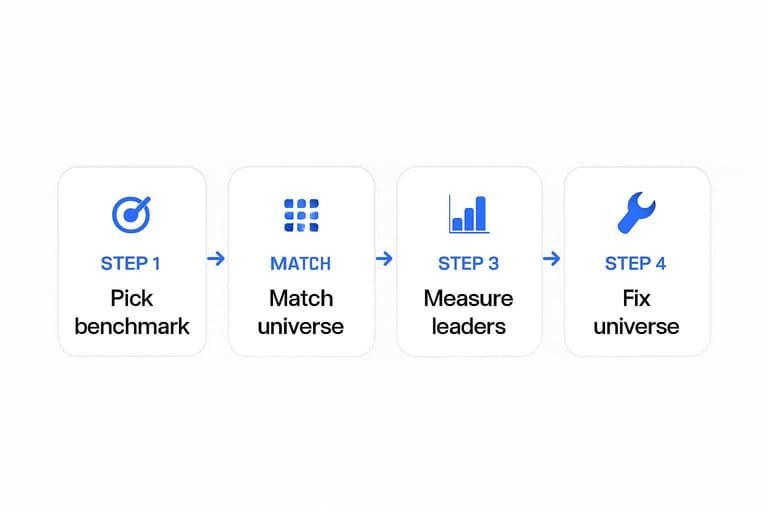
Benchmark and Universe Fix
Pick the wrong benchmark, and your screener buries the real leaders. A micro-cap winner looks “weak” versus the S&P 500, even while dominating its peers.
Use this mapping to match your style with the universe that actually contains your next buy.
| Investing style | Your universe | Benchmark | What you measure | |—|—|—| | Mega-cap growth | S&P 100 stocks | S&P 100 | Dominance at scale | | Large-cap core | S&P 500 stocks | S&P 500 | Broad leadership | | Small-cap growth | Russell 2000 stocks | Russell 2000 | Risk-on leaders | | Micro-cap momentum | Micro-cap lists | Micro-cap index | True breakouts | | Sector rotation | Sector constituents | Sector ETF | Intra-sector strength |
If your winner “disappears,” fix the universe first, not the stock.
Return Math Corrections
Your screener misses winners because your return math is dirty. Fix four inputs: adjusted prices, total return, consistent frequency, and one RS formula.
- Use adjusted close for every bar, including back history.
- Compute total return, not price return, with dividends and splits included.
- Pick one frequency (weekly works) and resample everything to it.
- Align timestamps, then calculate rolling returns over the same lookback window.
- Compute RS as stock total return minus benchmark total return, then rank.
Do this once, then stop debating “momentum” and start trusting your ranks.
Lookback Window Tuning
Your screener’s lookback window is a hidden bet about your holding period. Pick the wrong one and you either miss early leaders or buy late, then get chopped.
Think of it like using the wrong lens. A 12-month window won’t notice a fresh breakout, and a 20-day window will chase every “hot” candle.
Match holding period
Your lookback should match how long you typically ride a move. Otherwise you’ll rank stocks on returns you won’t actually hold through.
- Swing (2–10 days): 20–60 trading days
- Position (2–8 weeks): 3–6 months
- Trend (3–12+ months): 9–12 months
- Mixed book: blend two windows
If your ranks and your exits disagree, your screener becomes noise.
Use multi-horizon
Single-window strength has blind spots. A 3-month rank catches new leaders, but it also overreacts to sharp squeezes.
A practical blend is 3M/6M/12M ranks with more weight on the horizon you trade. For swing-position hybrids, try 50% 3M, 30% 6M, 20% 12M, then apply decay so last month matters most.
If the stock is real leadership, it shows up across horizons, not just one.
Add momentum hygiene
Raw relative strength loves one-week wonders. Add a few filters so you rank moves that can persist.
- Exclude names with a top-1% week in the last 10 days.
- Require price above the 50-day moving average.
- Require a 20-day higher high versus the prior 20 days.
- Ignore signals within 2 days after earnings gaps.
- Drop stocks with a 3-day reversal over 8%.
You’re not removing volatility. You’re removing fake strength.

Rebalance cadence
Daily refresh feels responsive, but it often just amplifies churn. Most leadership changes don’t require a new ranking every morning.
Weekly updates catch emerging winners early enough, while monthly reduces turnover for trend systems. If you see constant top-10 reshuffling, slow the cadence before you tweak the formula.
When the screener stops flinching, your portfolio stops bleeding on fees and regret.
(For research on turnover as a known side effect of some momentum definitions, see the FTSE Russell momentum factor paper.)
Ranking Method Upgrades
Raw percent change looks objective, but it quietly bakes in regime bias. A few extreme movers can swamp your list, and a volatility spike can crown the wrong “leader.” Upgrade the math, and your screener starts surfacing repeatable winners, not one-week wonders.
Rank, don’t scale
Percent change is a noisy ruler across different markets and different vol regimes. Ranks stay comparable, even when returns get weird, like a +40% meme spike.
Use robust ranking methods that ignore the tail wagging the dog:
- Percentile rank of returns, per lookback
- Cross-sectional z-score, winsorized at tails
- Median and MAD z-score for heavy outliers
- Composite rank across 1M/3M/6M windows
If you can’t compare scores across weeks, you can’t trust your “top 20.”
Volatility adjustment
High-beta names win raw RS screens because they swing harder, not because they lead better. You want momentum per unit of risk, not momentum per unit of hype.
Normalize momentum by volatility so the score rewards steadier strength:
- Return ÷ ATR%, like a practical Sharpe proxy
- Return ÷ realized volatility (20D or 60D)
- Excess return vs benchmark ÷ tracking error
- Z-score of relative returns ÷ vol percentile
When you de-bias for volatility, “leaders” start looking like leaders in down weeks too.
Relative line test
Plotting a price ratio forces a simple question: are you beating the benchmark right now. It turns “strong stock” into “stronger than the market.”
- Compute ratio: stock price ÷ benchmark price.
- Plot the ratio and add a 50-day moving average.
- Confirm the ratio makes higher highs and higher lows.
- Require ratio above its moving average for inclusion.
- Prefer rising moving average slope, not flat.
If the ratio is falling, your stock is just a market passenger.
Breakout confirmation
Pure RS often finds “strong” charts that are already extended or breaking down. Add a few price-action gates, and you stop buying the last candle.
- New 20D or 52W highs, not mid-range noise
- Tight consolidation, like a 3–8 week base
- Volume expansion on breakout day
- Breakout holds above pivot for 3–5 sessions
- Market regime filter: index above key MA
Your screener shouldn’t just find strength. It should find strength that can continue.
Make your screener earn its top 10 list
- Run the symptom check: pick 3 obvious recent winners and verify whether (and when) they enter your top ranks.
- Lock benchmark + universe: ensure the benchmark matches your mandate (cap/region/sector) and your universe matches what you can actually buy (liquidity, price, data coverage).
- Fix return math: use total returns, correct corporate actions (splits/dividends), and validate your calculation on a handful of tickers against a trusted source.
- Tune the lookback to the holding period: test 1–3 horizons (e.g., 3/6/12 months), apply basic momentum hygiene, and set a rebalance cadence that matches turnover.
- Upgrade ranking: rank (don’t min-max scale), consider volatility adjustment, and add a simple confirmation (relative line improvement or breakout) before you act.
Frequently Asked Questions
Does a relative strength stock screener still work in 2026 with AI-driven markets and faster rotations?
Yes—most relative strength stock screeners still work, but they need more frequent re-ranking (often weekly) and risk-aware filters to handle faster sector rotations and volatility spikes.
Do I need volume and liquidity filters in a relative strength stock screener to avoid false winners?
Usually yes. A simple rule like $2–$10M average daily dollar volume and a max spread threshold helps keep rankings from being dominated by illiquid names that can’t be traded or backtested realistically.
How do I measure whether my relative strength stock screener is actually finding winners?
Track forward 1-, 3-, and 6-month returns of your top decile versus the benchmark, plus hit rate (percent outperforming) and turnover; most screeners should show persistent edge in top ranks over multiple rebalance cycles.
Can I use RS rating tools (like TradingView or MarketSmith) instead of building a relative strength stock screener?
Yes—off-the-shelf RS ratings are a good starting point, but a custom relative strength stock screener lets you control the universe, rebalancing rules, and filters (liquidity, volatility, industry caps) that often decide real-world performance.
How long should I run a relative strength stock screener before trusting the results?
Give it at least 3–6 months of live signals across multiple rebalances, and validate with 5–10 years of out-of-sample backtests that include delistings, survivorship-bias-free data, and realistic trading costs.
Upgrade Your RS Leader List
Fixing relative strength screeners means getting the universe, return math, lookback windows, and ranking method right—then applying it consistently every day after the close.
Open Swing Trading delivers daily RS rankings, breadth, and sector/theme rotation context across ~5,000 stocks so you can surface cleaner breakout leaders faster—get 7-day free access with no credit card.
Sources
- MSCI Corporate Events Methodology (MSCI) — referenced in Corporate actions errors
- FTSE Russell Momentum Factor Paper (FTSE Russell Research) — referenced in Rebalance cadence