Why your sector rotation analysis loses money in chop
A practical troubleshooter for fixing sector-rotation strategies that bleed in sideways markets—diagnose chop-loss symptoms, identify regime-driven root causes, confirm chop with simple metrics, and apply signal/portfolio/execution upgrades you can validate with regime testing and walk-forward rules.
Why your sector rotation analysis loses money in chop
A practical troubleshooter for fixing sector-rotation strategies that bleed in sideways markets—diagnose chop-loss symptoms, identify regime-driven root causes, confirm chop with simple metrics, and apply signal/portfolio/execution upgrades you can validate with regime testing and walk-forward rules.
Your sector rotation model looks brilliant in trends—then chop shows up and the equity curve turns into a slow leak of small losses, whipsaws, and fees. If you’ve ever wondered why your “best sector” keeps flipping right before it reverses, you’re not alone.
This troubleshooter helps you pinpoint exactly where the money is disappearing: dispersion and correlation shifts, laggy signals, portfolio rules that amplify noise, and execution costs that compound. You’ll leave with concrete filters, construction tweaks, and a test plan to prove the fix holds up.
Table of Contents
- Chop Loss SymptomsClassic equity curveTape tellsRotation backtest smellHidden cost stack
- Root Causes In ChopDispersion collapsesCorrelation spikesSignal-lag mismatchCrowded factor exposure
- Confirm It’s Chop
- Pinpoint Your Failure Point
- Fix The Signal LayerAdd dispersion filterTrend confirmation gateUse robust rankingAvoid lookahead traps
- Fix Portfolio ConstructionWiden holding rulesControl beta and riskAdd defensive sleevesRebalance smarter
- Fix Execution And Costs
- Prove The Fix WorksRegime-segment testsStress your assumptionsWalk-forward processGo-live guardrails
- Lock in a chop-proof operating plan
- Frequently Asked Questions
- Spot Real Leaders In Chop
Chop Loss Symptoms
Sector rotation needs persistence to pay. In chop, you keep swapping seats on the same ride while costs keep running.
You’ll see it in your equity curve, in the tape, and in the way your backtest behaves before you ever trade live.
Classic equity curve
In chop, your curve bleeds in stair-steps: small losses stacked, with the occasional pop that doesn’t stick. You’ll notice lots of “-0.4%, -0.6%, -0.3%” weeks, then one +2% week that gets round-tripped.
In a trend, the same model looks clean: fewer trades, longer holds, and winners that run without constant re-ranking. That contrast is the tell.
Chop turns rotation into a loss-harvester, unless you add a regime filter or slow the cadence.
Tape tells
You can usually spot chop before your signals admit it. Watch for these behaviors in price and relative strength.
- Overlapping daily ranges across sectors
- Mean reversion after every “break”
- Low cross-sector dispersion
- Leadership flips every few sessions
- Breakouts that fail within days
If you see three or more, you’re not rotating into strength—you’re rotating into noise.
Rotation backtest smell
Chop shows up as frantic activity in the backtest: ranks shuffle constantly, holdings churn, and turnover spikes. You’ll also see performance coming from a few short windows, while most periods look flat-to-down.
A common giveaway is “regime capture”: 80% of gains land in one trend year, then a long sequence of tiny losses fills the rest. That’s not robustness; that’s luck plus persistence.
If your edge only appears when the market gifts momentum, you don’t have rotation—you have a trend detector with fees.
Hidden cost stack
Chop losses get amplified by costs you barely notice in a backtest. Each rebalance adds friction, and friction compounds.
- Wider spreads in rotating names
- Slippage on open/close rebalances
- Market impact from crowded switches
- Borrow costs on shorts
- Taxes from short holding periods
In chop, costs become the strategy, so fix turnover before you tweak signals.
Root Causes In Chop
Chop breaks rotation because the market stops rewarding differences. Relative strength still prints numbers, but the numbers stop meaning anything.
Dispersion collapses
Your edge comes from spread: winners pulling away from losers. In chop, returns cluster tightly, so a “top” sector might be up 0.3% while the “bottom” is down 0.2%.
Rankings then flip on tiny moves, and mean reversion starts paying better than trend. The trade turns into buying yesterday’s small winner right before it gives back.
Correlation spikes
Chop often hides a single driver: risk-on versus risk-off. When correlations jump, sectors move together, and your “leader” is mostly just high beta.
That makes winners indistinguishable, because everyone is responding to the same macro shove. Your rotation becomes a thin wrapper around market exposure.
Signal-lag mismatch
Your signal can be right and still lose if it arrives late. Chop punishes lag because leadership changes faster than your rules.
- Use slow lookbacks in fast regimes
- Rebalance monthly in weekly rotations
- Hold stale sector constituents
- Rely on delayed price or flow data
- Wait on reporting and revisions
Fix the clock speed first, or you’ll keep trading last month’s map.
Crowded factor exposure
Most “sector rotation” is really factor timing in disguise. You overweight what’s already working, then discover you loaded momentum, size, or quality without meaning to.
In chop, those factors mean-revert hard, and your sector call gets blamed for a factor unwind. That’s the line that gets crossed: you’re no longer rotating sectors, you’re renting crowded bets.
Confirm It’s Chop
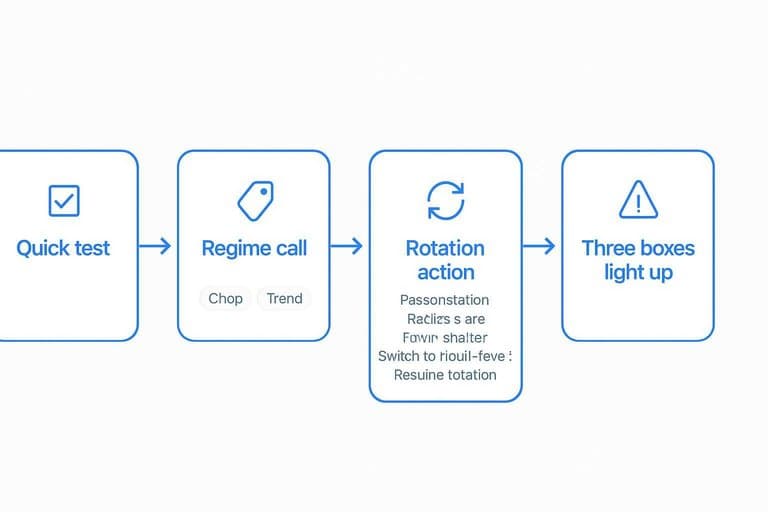
You lose money in chop because rotation signals fire, then reverse, then fire again. Use this table to label the regime fast and decide if rotation gets reduced, altered, or paused.
| What you see | Quick test | Regime call | Rotation action |
|---|---|---|---|
| Breakouts fail fast | 3+ failed highs/lows | Chop | Pause rotation |
| Leaders change weekly | Top 3 sectors rotate | Chop | Reduce bets |
| Breadth flips daily | A/D turns often | Chop | Trade smaller |
| Range holds for weeks | ATR stable, no trend | Chop | Switch to mean-revert |
| Trend resumes cleanly | Higher highs persist | Trend | Resume rotation |
If three boxes light up, you’re trading noise, not leadership.
Pinpoint Your Failure Point
You need a diagnostic that tells you where chop is stealing P&L. Run this workflow after any “great backtest, bad live” stretch.
- Freeze one month of trades and re-run it with the same prices.
- Swap in a dumb signal (equal-weight sectors) and keep everything else fixed.
- Keep your signal, but replace sizing with 1/N and no leverage.
- Keep signal and sizing, then remove slippage, fees, and delay assumptions.
- Re-enable one control at a time: stops, caps, rebalance rules, and exposure limits.
The first step that flips results from red to green is your failure point—fix that layer before touching the signal.
Fix The Signal Layer
Your rotation model isn’t “wrong” in chop. Your signal layer is underpowered.
In low-trend regimes, you need gates that demand real separation and real persistence before you rotate.
Add dispersion filter
Chop makes sector ranks shuffle for no reason. You gate trades until cross-sector dispersion clears a threshold, like “top-minus-median return > X” or “cross-sectional stdev > Y.”
Use simple filters:
- Cross-sectional stdev of sector returns
- Top–bottom spread over N days
- Percent of sectors outperforming benchmark
When dispersion is low, you’re not seeing leadership, you’re seeing noise. For a practitioner-friendly primer, see how dispersion in equity markets maps to the opportunity set for relative bets.
Trend confirmation gate
Dispersion tells you “there’s separation.” Trend confirmation tells you “it’s sticking.”
- Require MA slope positive over N days
- Require breakout holds for K closes
- Require ADX above a floor
- Require time-above-level before switching
If it can’t persist, it’s not leadership. It’s a head fake.
Use robust ranking
Plain momentum ranks flip when one sector has a freak week. Use robust ranking so outliers don’t hijack the leader board.
Combine signals like this:
- Multi-horizon momentum (1M, 3M, 6M)
- Volatility scaling so wild sectors don’t dominate
- Winsorization to cap extreme returns
Your ranking should reward consistency, not a single lucky candle.
Avoid lookahead traps
Most “great backtests” are quiet data leaks. Chop makes those leaks look like skill.
- Survivorship bias in sector universes
- Sector reclassifications applied retroactively
- Stale ETF histories and index changes
- Close-to-close fills with zero slippage
Fix the data first. Otherwise you’re optimizing a mirage.
Fix Portfolio Construction
Your signal can be fine and you still bleed in chop. The leak is usually construction: sizing too tightly, switching too fast, and letting risk drift when ranks jitter.
Widen holding rules
Chop turns small rank changes into constant trades. Your job is to add friction so you only move when the payoff is real.
Use rules like:
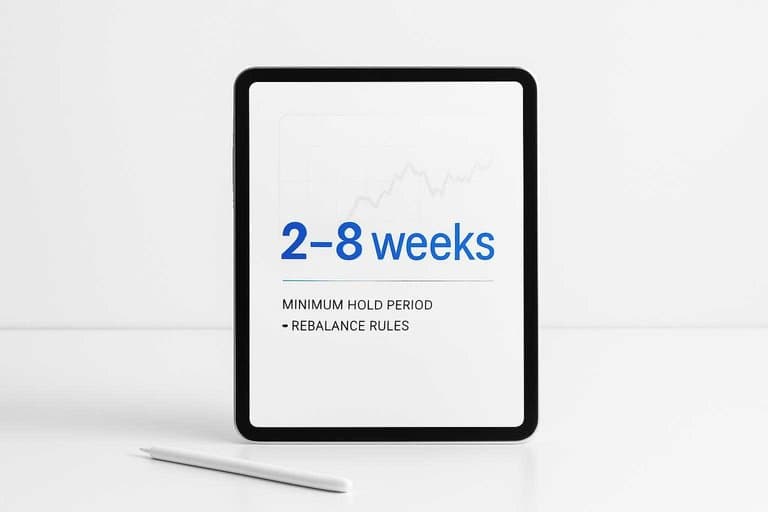
- Minimum hold period: hold winners and losers for 2–8 weeks.
- Rank buffer: don’t switch unless the new sector is top by N ranks.
- Hysteresis: require a rank-gap, like “beat by 3 points.”
- Dual triggers: enter on rank, exit on weaker threshold.
You’re not being lazy. You’re charging the signal rent for your attention.
Control beta and risk
Rotation strategies often smuggle in market beta and concentration. You want sector skill, not accidental leverage.
- Add a beta-neutral overlay with index futures
- Target portfolio volatility with scaled position sizes
- Cap max sector exposure per sleeve
- Limit positions using rolling correlation clusters
When beta stops dominating your P&L, your edge finally gets tested.
Add defensive sleeves
Chop is when your edge vanishes and your transaction costs stay. A defensive sleeve buys time without forcing you to “call the bottom.”
You can route a slice into cash, short-duration, or low-vol when a regime filter flips. Think “trend below zero” or “dispersion collapsed,” not vibes.
Your goal is to keep compounding while you wait for ranks to matter again.
Rebalance smarter
Most whipsaw comes from synchronized, all-in rebalances. You can keep the signal and lose less to timing.
- Stagger rebalances across weeks, not one day
- Move partially, like 25–50% toward target
- Use rebalance bands before trading
- Size by liquidity and bid-ask spread
The cheapest trade is the one your rules no longer force you to make.
Fix Execution And Costs
Chop turns “small edge” into “random noise” because your frictions compound faster than your signal. Treat costs like a bug, not a tax.
- Trade only when spread is within your cap
- Use limit orders at the mid when liquid
- Size by ADV, not conviction
- Batch rebalances to one window
- Audit fills versus VWAP weekly
If you can’t measure your edge after costs, you don’t have an edge. (See evidence that trading frictions can erase momentum-style profits in the illusory nature of momentum profits.)
Prove The Fix Works
Regime-segment tests
Chop breaks rotation systems because relative strength flips fast. You need proof the fix helps in chop, not just in easy trends.
Split history into regime buckets, then score each one separately.
- Define regimes with a simple filter: trend slope, vol, or ADX.
- Run identical rules in chop-only and trend-only slices.
- Demand chop improvement on net P&L and drawdown.
- Cap the damage to trend upside, like “no more than 10% hit.”
If the edge only shows up in trends, you didn’t fix chop. You hid it.
Stress your assumptions
Chop punishes anything fragile. Stress tests tell you if your “edge” survives bad but normal execution.
- Increase slippage by 2–3x
- Delay fills by 1–2 bars
- Cut liquidity in half
- Widen spreads during spikes
- Add random execution noise
If small frictions erase the gains, your fix is a backtest artifact.
Walk-forward process
Chop regimes repeat with different faces, so static tuning overfits fast. Walk-forward keeps you honest by forcing the rules to earn their keep.
Use a rolling train-test loop with locked constraints.
- Optimize on a fixed window, then trade the next window.
- Freeze parameter ranges, and keep them small.
- Limit knobs to the ones tied to a mechanism, not a curve.
- Track performance drift as regimes change.
Fewer degrees of freedom beats “perfect” settings every time.
Go-live guardrails
A fix that works in research can still bleed in production. Guardrails turn “we’ll notice” into a measurable tripwire.
- Monitor turnover vs baseline
- Track hit rate by regime
- Watch dispersion across sectors
- Enforce max drawdown threshold
- Kill-switch: 3 chop losses in a row
If you can’t stop it quickly, you’re not managing a strategy. You’re hoping.
Lock in a chop-proof operating plan
- Run the chop confirmation table on every review cycle and label the regime before you trade.
- Trace losses to one failure point (signal, construction, or execution), then apply only the matching fix so you don’t “overfit by piling on.”
- Re-test by regime segment, then walk-forward, and keep a small go-live guardrail set (turn-off thresholds, turnover caps, cost assumptions) to prevent silent decay.
- Treat chop as a normal operating state: if the strategy can’t survive low dispersion and high correlation, it’s not finished—keep iterating until it does.
Frequently Asked Questions
Does sector rotation analysis still work in 2026, or has it been arbitraged away?
It still works in many trending, dispersion-rich regimes, but the edge is smaller and more sensitive to costs than it was a decade ago. Most rotation systems fail today because they ignore regime filters and trade too frequently for their true signal-to-noise.
How do I measure whether my sector rotation analysis has a real edge after fees?
Track net expectancy per trade and per month, then compare it to your all-in cost per round trip (spread + commissions + slippage) using actual fills. If average net edge per trade is less than ~2–3× your typical round-trip cost, the strategy often won’t survive chop.
What’s the best benchmark for sector rotation analysis: S&P 500, equal-weight, or a sector index?
Use a total-return broad market benchmark (e.g., SPY/VOO) to answer “did rotation help at all,” and a sector-neutral benchmark (equal-weight sectors) to test whether your timing adds value beyond static sector exposure. Most investors need both to separate market beta from rotation skill.
Can I use factor rotation (value, momentum, quality) instead of sector rotation analysis to reduce chop losses?
Often yes—factor sleeves typically diversify sector-specific noise and can hold trends longer, which reduces turnover. You’ll still need the same discipline on costs and regime awareness, but factors can deliver cleaner relative signals than sectors in some sideways markets.
How often should I rebalance a sector rotation strategy to avoid overtrading in chop?
Monthly or even quarterly rebalancing often holds up better than weekly when markets are noisy, because it reduces reaction to short-lived relative strength flips. A practical test is to pick the slowest cadence that preserves most of your trend-regime gains while materially cutting turnover.
Spot Real Leaders In Chop
When chop turns sector rotation into whipsaws, the edge comes from cleaner leadership signals and faster regime awareness—without guessing which moves will stick.
Open Swing Trading surfaces breakout candidates with daily RS rankings, breadth, and sector/theme context so you can rebuild your rotation workflow around what’s actually leading. Get 7-day free access with no credit card.
Written with Skribra