
Why Your Stocks Trading PnL Flips Red Midweek
A practical troubleshooter for diagnosing why your trading PnL turns negative midweek—identify repeatable midweek symptoms, isolate regime shifts (events/liquidity/vol), pinpoint edge breakdown (signal decay/overtrading/exits), and audit positioning plus execution to fix the real leak.
Why Your Stocks Trading PnL Flips Red Midweek
A practical troubleshooter for diagnosing why your trading PnL turns negative midweek—identify repeatable midweek symptoms, isolate regime shifts (events/liquidity/vol), pinpoint edge breakdown (signal decay/overtrading/exits), and audit positioning plus execution to fix the real leak.
You start the week green, then somewhere around Tuesday or Wednesday your PnL flips—same setups, same market, suddenly different outcome. If it keeps happening, it’s rarely “bad luck.” It’s usually a pattern you’re not measuring yet.
This troubleshooter helps you spot the midweek telltales, connect them to regime and execution changes, and run a fast audit that isolates whether the culprit is market structure, strategy decay, exposure clustering, or broker fills—so you can make one focused change instead of ten random ones.
Spot the Pattern
A “midweek red flip” is when your week starts green, then turns red around Wednesday and stays heavy. It’s common because risk, liquidity, and your own behavior often change after two days of feedback. Treat it as a hypothesis until your data shows the same shape across many weeks, not one ugly Wednesday.
Midweek red symptoms
You’re looking for a repeatable week-shape, not a single bad day. These signs usually cluster together when the flip is real.
- Green Monday/Tuesday, red Wednesday
- Win rate drops midweek
- Fills worsen and slip more
- Trade churn rises, conviction falls
- Commissions climb from overtrading
If three or more show up often, you have a pattern worth fixing.
Quick sanity checks
Before you diagnose psychology or “the market,” rule out basic noise. You need enough trades and clean attribution.
- Check sample size across 8–12 weeks.
- Remove one-off outliers and re-run the week view.
- Separate overlapping positions from new entries.
- Split results by ticker and by strategy tag.
- Confirm one bucket isn’t driving all losses.
If one name or one setup explains it, fix that first.
Minimal tracking setup
You don’t need a quant stack to confirm the flip. You need a daily log that ties PnL to trade quality and risk.
Track daily PnL, expectancy, win rate, average win, average loss, slippage, and net exposure. Add one note per day like “chased open” or “held into FOMC.”
The point is simple: you can’t fix what you can’t separate.
Regime Shift Drivers
Midweek PnL flips usually aren’t “you getting worse.” The market’s rules change fast, and your edge is priced for Monday–Tuesday conditions.
Event calendar shocks
Tuesday close to Thursday open is where the calendar concentrates risk. CPI, FOMC, jobs data, and earnings clusters can turn a tidy range into a gap-and-go mess.
When a major release hits midweek, ranges expand and opens gap more often. Your tight stop model assumes continuous prices, but the market jumps. One ugly print can skip your stop and fill you at the next liquidity node. That’s how a “0.5R loss” becomes a “2R slip” without any new mistake.
Trade the calendar, or the calendar trades you. (If you want to plan it precisely, use the official CPI release schedule.)
Liquidity and spreads
Liquidity is not constant across the week, even in large caps. Wednesday and Thursday often bring depth changes around auctions, macro headlines, and dealer re-hedging.
When depth thins, spreads widen and your marketable orders pay more. Stops become easier to tag because the bid-ask “breathes” wider, then snaps back. You see a clean chart, but your fills look like you traded a different instrument. If you scalp, one extra tick of spread can erase your entire premise.
Measure slippage by weekday, then size and order-type should follow.
Volatility compression traps
Early-week price action often drifts and compresses implied and realized volatility. Then midweek catalysts re-expand vol and punish trades built for quiet tape.
- Drift tightens ranges and hides true risk
- Compression rewards mean-reversion entries
- Expansion breaks levels without clean retests
- Expansion turns “breakouts” into slippage
- Snapback stops out late chasers
When vol expands, your edge needs wider stops or fewer trades. (For a standardized proxy of implied vol, see the Cboe VIX methodology.)
Strategy Edge Breakdown
Signal half-life
Most stock signals have a half-life. By Wednesday, yesterday’s “clean momentum” often becomes a crowded, late entry.
Momentum and mean-reversion both decay, just differently. Momentum fades as volatility compresses and buyers thin out. Mean-reversion fades as the easy snapback already happened. Your continuation entry then pays worse prices, needs tighter timing, and delivers smaller R multiples. Think “it still looks strong” right before it stops paying.
If your win rate stays similar but R drops midweek, your edge is arriving late, not disappearing.
Overtrading spiral
Midweek red often comes from behavior, not the market. The first small loss changes how you take the next five.
- Chase back losses with revenge entries
- Increase trade count to “make it back”
- Lower selectivity on marginal setups
- Skip no-trade filters and time windows
- Add size after a losing streak
Fix the process trigger, not the chart pattern. The spiral starts the moment rules become “optional.”
Exit logic mismatch
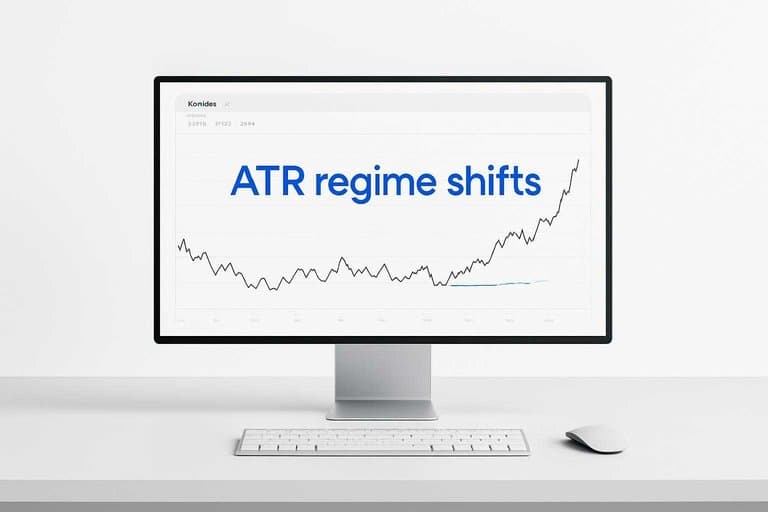
Your exits can be correct on Monday and wrong on Wednesday. ATR and intraday range often shift midweek, and fixed stops or targets stop fitting.
- Tag every midweek loss by exit type: stop, time exit, or reversal exit.
- Compare midweek ATR to your stop distance in ATR terms.
- Check if targets are reached less, or just reached later.
- Test a volatility-scaled stop and a volatility-scaled target.
- Add a condition: “no new entries when ATR regime shifts.”
When ATR changes, fixed exits turn into random exits. That’s the line between strategy and hope.
Positioning and Exposure
Midweek red often shows up when your “variety” is actually one big bet. You think you’re trading names, but you’re really trading exposure.
Correlation clusters
You can own five tickers and still be making one trade. It happens when your positions share the same driver, like “AI semis” or “regional banks.”
A quick concentration check you can run:
- Map each position to sector and theme buckets
- Compare each name’s correlation to SPY and its sector ETF
- Track your portfolio’s beta, not just position count
- Cap exposure per driver, not per ticker
If three names move together on the same headline, you’re not diversified. You’re levered. (Weekday effects in returns/volatility are a known, measurable phenomenon—see day-of-the-week effect evidence.)
Overnight gap risk
Midweek is packed with catalysts, and gaps ignore your stop. You need to know if your edge is intraday skill or overnight luck.
- Split your PnL into intraday and overnight buckets.
- Tag each overnight hold with a catalyst label.
- Calculate average overnight return and worst gap loss.
- Set separate risk limits for overnight positions.
- Reduce holds when overnight expectancy turns negative.
When overnight is bleeding, stop pretending it’s “part of the strategy.” It’s a different game.
Sizing drift signals
Your size can drift without you noticing, especially after a clean run. Midweek is when that drift meets a normal pullback.
- Increasing size after wins
- Widening stops without new risk math
- Skipping your daily loss limit
- Adding “just one more” correlated position
- Treating margin as free room
Your system didn’t break midweek. Your risk crept up until variance collected.
Broker and Execution Issues
Midweek red PnL often comes from execution friction, not your thesis. A single routing change or borrow loss can turn “great idea” into “bad trade.”
| Execution issue | What you notice | Why it hits midweek | Quick check |
|---|---|---|---|
| Partial fills | Slippage, missed size | Liquidity shifts | Compare limit vs fill |
| Smart routing change | Worse spreads | Broker adjusts venues | Inspect route codes |
| Volatility halts | Stuck, gapped exits | Catalysts cluster Tue–Thu | Check halt logs |
| Borrow recall | Forced cover | Locates tighten | Verify borrow status |
| Wrong order type | Bad entry, stop run | Faster tape midweek | Review order tickets |
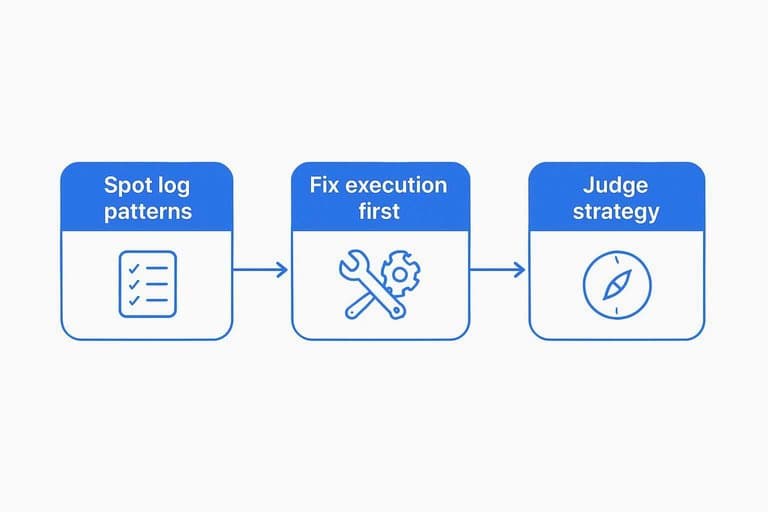
If your logs show these patterns, fix execution first, then judge your strategy.
Run a Midweek Audit
Your Wednesday flip is rarely “bad luck.” It’s usually one lever changing midweek, like regime, sizing, or execution. Pull your journal plus broker exports, then audit like you would debug a production incident.
Segment the data
You need cuts that reveal where expectancy breaks. Slice until the red concentrates in one bucket.
- Export fills and PnL, then add a day-of-week column.
- Group by setup, then by hold time buckets (e.g., 0–30m, 30–120m, swing).
- Split by market regime tags (trend, chop, news, earnings week).
- Segment by ticker and liquidity tier (mega, large, mid, small).
- Rank segments by expectancy and isolate where Wednesday turns negative.
When one segment drives most of the red, you’ve found the lever worth fixing.
Find the loss source
Once you’ve found the “bad bucket,” identify what changed inside it. You’re looking for a mechanical shift, not a mood swing.
Check four culprits:
- Win rate collapse: same losses, fewer wins.
- Average loss expansion: losers get bigger midweek.
- Slippage and fees: entries worsen, exits leak, commissions bite.
- A+ setup scarcity: you trade B setups to stay active.
If win rate drops but avg loss stays flat, your filtering failed. If avg loss expands, your risk control failed.
Quantify stop and ATR
Stops usually fail midweek because volatility changes while your stop rule stays static.
| Day | Median ATR | Median stop | Stop/ATR |
|---|---|---|---|
| Mon | Higher | Medium | 0.7x |
| Tue | Medium | Medium | 0.9x |
| Wed | Medium | Tight | 0.5x |
| Thu | Higher | Tight | 0.4x |
| Fri | Lower | Medium | 1.2x |
If Stop/ATR shrinks on Wednesday, you’re getting clipped by noise. Widen stops or reduce size, then retest.
Run the 30-Minute Midweek Fix
- Freeze variables for one week: keep your strategy rules and max risk constant; don’t “fix” things midstream.
- Segment your results: split PnL by day (Mon/Tue/Wed/Thu/Fri), time of day, setup type, and holding period (intraday vs overnight).
- Locate the leak: compare green vs red buckets for slippage, win rate, average win/loss, and trade count—identify whether it’s execution, overtrading, or edge decay.
- Quantify stops vs volatility: map stop distance to ATR/realized vol; if midweek vol compresses or expands, adjust position sizing or stop logic (not both at once).
- Check exposure and correlation: flag weeks where multiple positions move as one (same sector/factor); cap cluster risk and overnight gap exposure.
- Make one change and retest: apply a single constraint (trade filter, size cap, time window, or exit rule), then re-run the same segmentation next week to confirm the midweek flip is shrinking.
Frequently Asked Questions
Does a midweek PnL dip in stocks trading mean my strategy stopped working?
Usually not—it often signals a temporary shift in volatility, liquidity, or news flow rather than a permanent edge loss. Validate it with at least 30–50 comparable trades and segment results by day-of-week before making major changes.
How do I measure whether my Wednesday losses come from overnight risk or intraday execution in stocks trading?
Split PnL into overnight (close-to-open) and intraday (open-to-close) using your fills plus daily OHLC data, then compare hit rate and average loss by segment. Most traders find the culprit quickly when they isolate gaps, slippage, and time-in-trade separately.
What adjustments can reduce a midweek red flip without changing my entire stocks trading system?
Most traders get the biggest improvement by reducing size on Wednesday, tightening max daily loss limits, and shortening holding time during the midweek window. Add a simple day-of-week risk filter (e.g., 25–50% size cut) and re-evaluate after 4–6 weeks of data.
Can I hedge midweek drawdowns in stocks trading without adding complex options strategies?
Yes—many traders hedge simply by lowering net beta (smaller size, fewer correlated positions) or using a broad-market ETF as a partial offset. The goal is to reduce portfolio sensitivity during the specific midweek period where your losses cluster.
How long should I track results before concluding my midweek red flip is a real problem in stocks trading?
Track at least 6–12 weeks or 100+ trades (whichever comes first) to smooth out randomness and see repeatable patterns. Re-check after major market changes (earnings season, rate decisions) because day-of-week effects can strengthen or disappear.
Stay Green Through Midweek
Midweek red PnL is usually a regime shift, exposure drift, or a leadership rotation you didn’t catch in time—especially when execution noise creeps in.
Open Swing Trading helps you run that midweek audit faster with daily RS rankings, breadth, and sector/theme rotation context—get 7-day free access with no credit card.
Sources
- Schedule of Releases for the Consumer Price Index (U.S. BLS) — referenced in Event calendar shocks
- Cboe VIX Index Methodology (official PDF) — referenced in Volatility compression traps
- The evolution and cross-section of the day-of-the-week effect (NYSE/AMEX/NASDAQ; CRSP data) — referenced in Correlation clusters