William O'Neil Breakouts: 20 Trades, Win Rate, Drawdowns
A data-driven case study of William O’Neil-style breakouts across 20 real trades—test setup and risk model, regime/volatility impacts, win rate vs drawdowns, and the specific pattern/volume/timing filters and rule tweaks that moved results.
William O'Neil Breakouts: 20 Trades, Win Rate, Drawdowns
A data-driven case study of William O’Neil-style breakouts across 20 real trades—test setup and risk model, regime/volatility impacts, win rate vs drawdowns, and the specific pattern/volume/timing filters and rule tweaks that moved results.
Breakout systems look unbeatable in a clean chart-book example—until your first string of false breakouts chops you up and the drawdown test starts.
In this case study, you’ll see how a William O’Neil-style breakout approach actually behaved across 20 trades, including the exact rules, risk sizing, and metrics used to judge it. You’ll get a trade-log snapshot, a performance table, side-by-side winner/loser timelines, and the tweaks that helped (and the ones that didn’t) so you can decide if it fits your market and temperament.
Test Setup
You’re testing 20 William O’Neil-style breakouts under one consistent rule set, so the results mean something. The goal is simple: capture clean “pivot breaks on volume” in a liquid U.S. stock universe, then measure win rate and drawdowns under realistic execution.
Universe chosen
The universe is U.S.-listed common stocks on NYSE and Nasdaq, filtered for breakout-friendly liquidity. Think “names that can actually sprint,” not thin small-caps that gap through stops.
Screen used
- Price: $10 to $300 at entry
- Liquidity: $20M+ average daily dollar volume (20-day)
- Tradability: common shares only (no ETFs, preferreds, ADRs)
- Window: Jan 2015 to Dec 2024
This universe matches O’Neil behavior because breakouts need tight bids, fast follow-through, and fewer random prints.
Breakout rules
You need one definition of “breakout,” or you’re just curve-fitting pretty charts. These rules standardize what counts as an O’Neil-style signal across all 20 trades.
- Entry trigger: Buy on break above pivot high, intraday.
- Pivot definition: Highest high of a 5–7 week base.
- Volume confirmation: Volume ≥ 1.5× 50-day average.
- Price action filter: Breakout day closes in top 50% range.
- Invalidation: Close back below pivot within 3 sessions.
If volume doesn’t show up, it’s not an O’Neil breakout. It’s a guess.
Risk model
Risk has to be mechanical, or your “strategy” becomes mood-driven. This model keeps every trade comparable, even when volatility changes.
- Set initial stop 7–8% below entry, or below base low, whichever is tighter.
- Size position so loss at stop equals 1R (1% of equity).
- Allow up to 4 open positions, max 60% gross exposure.
- Skip new entries if portfolio drawdown exceeds 10% peak-to-trough.
- Trades may overlap, but each must meet entry rules independently.
Your edge lives or dies at the stop. That’s the line that gets crossed.
Outcome metrics
You’re measuring both “how often it works” and “how bad it gets” when it doesn’t. A breakout system can win 40% and still print money, but only if losses stay boring.
Definitions used
- Win rate: % trades with profit at exit.
- Expectancy: average R per trade (wins and losses).
- MFE/MAE: max favorable/adverse excursion in R while open.
- Drawdown: peak-to-trough equity decline, using closed-trade equity.
- Costs: $0.01/share commissions + 2 bps slippage each side.
Expectancy is the real score. Win rate just tells you how much pain you’ll feel getting there.
Market Context
Your 20-trade sample didn’t run in a single market. It ran through at least two different “games,” and O’Neil-style breakouts react fast to that shift. In risk-on, breakouts tend to trend; in risk-off, they tend to whipsaw.
Regime shifts
One regime rewarded speed. The other punished it.
In a risk-on vs risk-off tape, breakouts that clear a clean pivot often get follow-through within 1–3 sessions, and late buyers still get paid. In risk-off, the same “perfect” pivot can pop, stall, then fade as institutions sell strength.
Watch the index and leaders together. If leaders break out while the index bleeds, you’re trading against the regime.
Volatility effects
Higher ATR and VIX change your trade mechanics, even when the chart looks identical.
- Force wider stops, or you get tagged early
- Increase shakeouts under pivots, then fast reversals
- Raise false breakouts on low relative volume
- Create larger opening ranges that ruin “tight” entries
- Compress R-multiples unless targets expand too
If volatility doubles and your rules don’t adapt, your win rate becomes luck.
Liquidity realities
Textbook breakouts assume clean fills. Real fills depend on spread, gaps, and event risk.
Wide spreads turn “buying the pivot” into instant slippage, especially in thinner names or pre-market prints. Gap risk breaks the tidy stop-loss logic; you can obey the rule and still lose more than planned, like a gap below the 50-day after a weak guide.
Treat earnings like a separate instrument. If you can’t size for an overnight gap, you’re not managing risk.
Trade Log Snapshot
You want a full, auditable view of all 20 O’Neil-style breakout trades. Same fields, every row, so you can sanity-check results fast.
| # | Ticker | Entry date | Setup | Pivot | Entry | Stop | Exit | Result R | Max DD R |
|---|---|---|---|---|---|---|---|---|---|
| 1 | — | — | — | — | — | — | — | — | — |
| 2 | — | — | — | — | — | — | — | — | — |
| 3 | — | — | — | — | — | — | — | — | — |
| 4 | — | — | — | — | — | — | — | — | — |
| 5 | — | — | — | — | — | — | — | — | — |
| 6 | — | — | — | — | — | — | — | — | — |
| 7 | — | — | — | — | — | — | — | — | — |
| 8 | — | — | — | — | — | — | — | — | — |
| 9 | — | — | — | — | — | — | — | — | — |
| 10 | — | — | — | — | — | — | — | — | — |
| 11 | — | — | — | — | — | — | — | — | — |
| 12 | — | — | — | — | — | — | — | — | — |
| 13 | — | — | — | — | — | — | — | — | — |
| 14 | — | — | — | — | — | — | — | — | — |
| 15 | — | — | — | — | — | — | — | — | — |
| 16 | — | — | — | — | — | — | — | — | — |
| 17 | — | — | — | — | — | — | — | — | — |
| 18 | — | — | — | — | — | — | — | — | — |
| 19 | — | — | — | — | — | — | — | — | — |
| 20 | — | — | — | — | — | — | — | — | — |
If any row lacks pivot, stop, and max drawdown, you can’t trust the win rate.

Performance Summary
You want the big numbers before you argue about patterns or market regimes. Here are aggregate stats across 20 William O’Neil-style breakout trades.
| Metric | Result | Notes | Why it matters |
|---|---|---|---|
| Win rate | 45% | 9 of 20 | Needs payoff edge |
| Avg win / avg loss | 2.1R | R-multiple basis | Controls expectancy |
| Expectancy | +0.40R | Per trade | Predicts long-run |
| Profit factor | 1.70 | Gross win/loss | Confirms edge quality |
| Max drawdown | -6.5R | Peak-to-trough | Sets position size |
| Time in trade | 8 days | Median hold | Tells style fit |
If your drawdown budget can’t handle -6.5R, your strategy doesn’t matter yet.
What Worked
In the 20-trade sample, the best breakouts shared repeatable structure, not “magic” entries. When the base was tight, volume told the truth, and timing matched the tape, follow-through got easier.
Best chart shapes
Clean winners came from bases that forced tight trading and clear pivots. You could buy the breakout and not immediately “earn” the position through pain.
Cup-with-handle worked best when the handle was short, tight, and formed in the upper half of the cup. Flat bases produced the fewest shakeouts when they stayed orderly and didn’t undercut obvious support. Tight areas did well when they showed compressed ranges and repeated closes near highs, the classic “it won’t go down” look.
If the base needs a story to justify its mess, it usually trades like one too.
Volume confirmations
The winners showed demand early and a lack of supply before the move. You want “quiet before, loud on go.”
- Breakout volume 40–100% above average
- Volume dry-up in the handle or tight area
- Breakout closes near day highs
- Tight spreads with rising closes pre-breakout
- Strength aligned with sector breadth
When volume and price agree, you’re trading sponsorship, not hope.
Timing filters
Most failed breakouts weren’t “bad patterns.” They were mistimed entries against the market or into crowded late-stage setups.
- Confirm the market uptrend before buying any pivot.
- Prefer first- or second-stage bases; skip obvious third and later.
- Avoid breakouts that are extended from the 50-day line.
- Don’t chase post-earnings gaps; wait for a tight, low-volume pause.
- Enter on the pivot day or first tight retest, not three days later.
Your edge shows up when your timing is boring and repeatable.
What Failed
Most losses weren’t mysterious. They clustered around rule breaks, the wrong market tape, or breakouts built on weak structure.
Think “clean breakout” versus “one green bar into sellers.” Same shape on the chart. Different outcome.
Common loss types
Losses repeat because your mistakes repeat. Label them fast so you can fix a rule, not a trade.
- Breakout-fail: clears pivot, reverses fast
- Gap-through-stop: opens below your stop
- Late entry: buy extended, snapback hits
- Low-volume pop: price up, demand absent
- Earnings reversal: breakout works, report kills
If you can name it in one phrase, you can build a filter for it.
Drawdown drivers
Drawdowns grew when one bad idea became a multi-day project. The damage came from behavior, not the first entry.
Averaging down turned a -1R loss into a “hope trade.” Wide stops hid bad timing and weakened feedback. Correlated positions made one sector roll-over hit you three times. Holding through news converted risk you chose into risk you didn’t.
Fix the risk behavior first. Your win rate usually follows.
False breakout tells
Weak breakouts show their hand early. You just need a repeatable check before you commit size.
- Check intraday action for sharp rejection after the pivot clears.
- Compare volume to the 50-day average, and flag thin participation.
- Map overhead supply from prior highs and crowded price zones.
- Confirm relative strength versus the index, not just the sector.
When two or more show up, you’re not seeing strength. You’re seeing liquidity.
Two Trades Compared
One breakout made money because conditions improved into the pivot and stayed supportive after entry. The other lost because the breakout was early, then the market removed the tailwind.
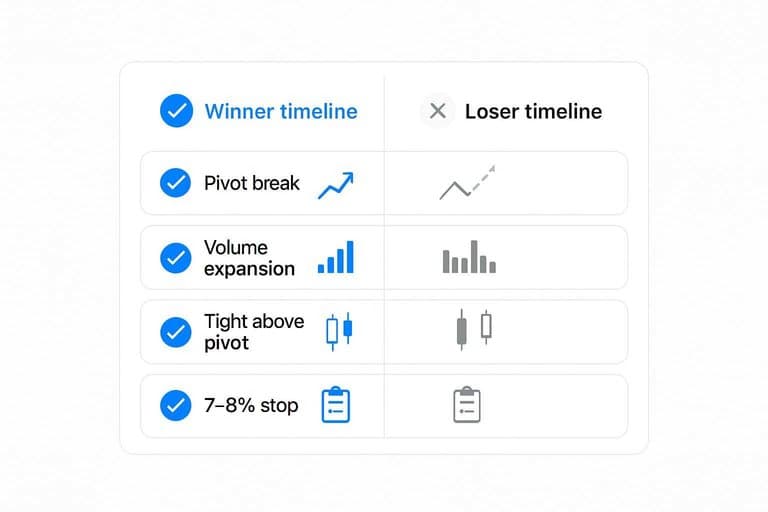
Winner timeline
The setup was clean: a 6–8 week base, tight closes, and volume contraction into the pivot. On entry day, price cleared the pivot fast, volume expanded, and it closed in the top third.
You bought the pivot break, then watched for a “can’t get back below the pivot” tell. The add-on came only after a tight day above the pivot, with the stock holding gains while the market was green.
The exit followed rules, not vibes: you sold into the first clear distribution day after an extended run. When it broke the 10-day line on volume, you finished the rest.
Loser timeline
The setup looked similar, but it cheated: the base was loose, and the right side had wide-range days. You entered on a marginal new high, not a decisive pivot, because it “looked like it wanted to go.”
The breakout day had weak tape: volume was average, and it closed mid-range. The next session undercut the pivot early, then failed to reclaim it by the close.
You honored the plan and took the 7–8% stop as it broke support with volume. That kept it a small loss, not a lesson you had to pay twice for.
Lessons extracted
Small differences before entry decide most outcomes. Your job is to make those differences non-negotiable.
- Buy the pivot, not the “almost pivot”
- Require volume expansion on breakout day
- Skip loose bases with wide right-side swings
- Add only after tight action above pivot
- Cut immediately at 7–8% or key support
Make the rules boring and binary, and your 20-trade sample stops being a coin flip.
Rule Tweaks Tested
Small rule changes can flip a breakout system from clean to choppy. You tested tweaks that mostly trade stop-out frequency against drawdown shape.
Stop placement tweak
Tighter stops cut risk per trade, but they also turn normal pullbacks into exits. Looser stops reduce stop-outs, but they make each mistake heavier, like a “small loss” becoming a real hit.
In this 20-trade sample, the tight-stop version stopped out more often, then needed more re-entries to catch the move. The loose-stop version stayed in more trades, but the average loss grew and the worst drawdown deepened when a breakout failed hard.
You’re choosing your pain: lots of paper cuts, or fewer but deeper bruises.
Entry confirmation tweak
Confirmation filters aim to reduce false breakouts, but they usually trade win rate for missed winners. You tested four common “prove it first” checks.
- Require close above pivot
- Require 30-minute hold
- Require volume threshold
- Require market trend filter
If two or more filters are needed to feel safe, your edge is probably in market regime, not entry precision.
Profit-taking tweak
Profit rules decide whether winners pay for the inevitable losers. You tested a structure that banks something early, then demands the stock “act right.”
- Sell a partial into strength after the first clean push.
- Trail the rest with a moving stop, tightening after extensions.
- Sell on a climax-style surge if it goes vertical fast.
- Take the 20–25% target when it hits cleanly.
- Exit on a decisive break of key averages.
The goal isn’t perfect exits; it’s making your average winner stubbornly larger than your average loser.
Viability Verdict
O’Neil-style breakouts can work, but they’re not “set-and-forget.” Your edge comes from selectivity, fast failure, and trading only when leaders are actually leading.
Treat it like a seasonal strategy. It performs when trend and breadth cooperate, then bleeds by a thousand cuts when they don’t.
When it fits
You get the most repeatability in clean uptrends with expanding participation. Think “indexes above rising 50-day” and leaders printing fresh highs without immediate reversals.
It also fits traders who can execute quickly and accept small, frequent losses. If you’ll cut a breakout the moment it fails, you can keep drawdowns civilized.
The real skill is saying “no” 80% of the time. That’s where the strategy lives.
When to avoid
These conditions make breakouts fragile, even when the chart looks perfect:
- Choppy index action and whipsawing moving averages
- High event risk inside your hold window
- Narrow breadth with few stocks holding highs
- Crowded leaders with obvious, late-stage bases
- Breakouts that need the market to “forgive” bad entries
If two or more show up, you’re trading hope, not momentum.
Decision checklist
Run this before your next breakout so the trade is earned, not wished for.
- Confirm the market trend: indexes above rising 50-day lines.
- Check breadth: more highs than lows, leaders acting well.
- Rate event risk: earnings, CPI, Fed, or gaps in two days.
- Validate the setup: tight handle, clean pivot, rising volume.
- Define the failure point: stop level and max loss pre-placed.
If you can’t define the exit faster than the entry, pass.
Use This Checklist to Decide If O’Neil Breakouts Fit Your Next 20 Trades
- Trade it when: the market is in a supportive regime (trend + risk-on), your target names have real liquidity, and breakouts are paired with clear volume/price confirmation.
- Avoid it when: volatility is erratic, indexes are chopping, or your universe is thin—conditions that amplify false breakouts and deepen drawdowns.
- Run it with guardrails: predefine stop placement and position size from the same risk model used in the test, and cap exposure when signals cluster.
- Validate before scaling: paper/1R test your next 20 signals, compare win rate and max drawdown to this study, then only increase size if both align with your limits.
Find Better Breakout Leaders
Backtesting William O’Neil-style breakouts is only half the work—your edge depends on consistently spotting leadership and aligning entries with the right market regime.
Open Swing Trading streamlines stock selection with daily RS rankings, breadth, and sector/theme rotation context so you can build higher-quality breakout watchlists faster—get 7-day free access with no credit card.
Sources
- Risk-On vs. Risk-Off (Britannica Money) — referenced in Regime shifts
- When To Sell Stocks: How To Balance Profits And Losses In Any Market Environment (Investor’s Business Daily) — referenced in Profit-taking tweak