William O'Neil Explained for Breakout Swing Traders
An explainer for breakout swing traders on William O’Neil’s method—understand the breakout premise, apply CAN SLIM as a decision lens, spot bases/pivots/handles, read volume tells, and execute entries with 7–8% stops plus sizing and pyramiding rules.
William O'Neil Explained for Breakout Swing Traders
An explainer for breakout swing traders on William O’Neil’s method—understand the breakout premise, apply CAN SLIM as a decision lens, spot bases/pivots/handles, read volume tells, and execute entries with 7–8% stops plus sizing and pyramiding rules.
If you’ve ever bought a “breakout” that instantly failed, you already know the hard part isn’t finding a chart pattern—it’s knowing when the setup is real. William O’Neil’s work is famous, but most traders absorb the headlines and miss the execution details.
This explainer translates O’Neil into swing-trader language: how CAN SLIM filters candidates, what qualifies as a proper base and pivot, how volume confirms (or warns), and the entry/risk rules that keep one bad trade from wrecking your month.
O’Neil in One Map
William O’Neil’s core idea is simple: buy leading stocks as they break out of clean bases, only with confirmation, and cut risk fast. Think “strong names, clear pivots, heavy demand,” then defend your downside like it’s the whole game.
Who O’Neil Was
William O’Neil founded Investor’s Business Daily and popularized CAN SLIM, a ruleset built from studying past super-winners. His framework stuck because it gave growth traders a repeatable way to buy strength, not stories.
The Breakout Premise
Institutions move prices because their orders are huge and repeated over time. A breakout works when buying pressure overwhelms supply at a known pivot, like “through $50 on volume.”
Swing Trader Translation
You’re not running an investment fund, but the mechanics stay the same. You just compress the timeline and tighten feedback.
- Prefer 2–6 positions, not 20
- Target 1–20 day moves, not quarters
- Use tighter stops, usually 3–7%
- Demand quick progress, within 1–3 days
- Exit faster when volume fades
Your edge is speed: you can bail early while institutions are still “evaluating.”
The CAN SLIM Lens
Use CAN SLIM like a pre-flight checklist, not a crystal ball. You’re filtering for leadership traits that institutions can actually buy and defend.
When each letter points the same direction, breakouts behave cleaner. When they don’t, you’re forcing trades.
C and A
C is current earnings and A is annual earnings because institutions pay for growth that’s accelerating, not merely “good.” When growth speeds up, funds can justify paying up, and they start building positions.
Look for acceleration first, then consistency:
- C: EPS and sales growth rising, quarter over quarter
- A: multi-year EPS trend, ideally strong and improving
- Margins: expanding, not shrinking
- ROE: durable, not one-off
If fundamentals are messy, use proxies that still track demand:
- Revenue acceleration when EPS is distorted
- Gross margin trend when accounting noise dominates
- Guidance raises, not just “beats”
- Cash flow direction when EPS is engineered
You’re not predicting earnings. You’re checking whether big buyers have a story they can keep buying.
N and S
N is the reason institutions re-rate a stock, and S is whether the tape can support a clean breakout. “New” changes perception, and supply decides how far price can travel.
- New product line that changes growth slope
- New management with credible execution
- New market, segment, or distribution channel
- New high after a long base
- New earnings power via guidance raise
Float and volume shape breakout quality:
- Low float can move fast, and fail fast
- Higher float needs real accumulation volume
- Breakout volume should expand, not fade
- Tight closes show supply getting absorbed
If volume doesn’t confirm, supply is still in control.
L and I
L is leadership: you want the stock that institutions must own, not the one “catching up.” I is sponsorship: enough ownership to support the trend, not so much that everyone who wants in is already in.
Spot leadership with simple checks:
- Relative Strength line making new highs
- Price holding above key moving averages
- Strong action on green days, quiet red days
Gauge sponsorship without overthinking it:
- Some top-tier funds present is a plus
- Rapid fund-count spikes can mean crowding
- Heavy ownership plus flat price signals distribution
Leadership is what breaks out. Crowding is what breaks down.

M Matters Most
M is the filter that saves you from perfect setups in a bad tape. For more on timing the market leg of CAN SLIM, see this overview of follow-through days.
Bases and Pivots
A base is price going sideways after a run. It’s a battle between sellers who want out and patient buyers who keep absorbing shares.
The pivot is the truce line. When price clears it with force, demand finally wins.
Common Base Types
Base names are just shorthand for crowd behavior. Learn what each shape implies, not the artwork.
- Cup-with-handle: pullback, recovery, then a tight final pause
- Flat base: tight range after gains, little selling pressure
- Double bottom: failed bounce, retest, then a stronger second push
Treat each as a volatility compression story, then buy the breakout.
Pivot, Handle, Shakeout
The pivot is the key price where the base “fails” for shorts and “works” for buyers. It’s usually the prior high inside the base, and it’s the line you want price to clear on volume.
A handle is a controlled dip near the top that bleeds off weak holders. A shakeout is the rude version, a quick undercut that scares late buyers and triggers tight stops.
Prioritize clarity over perfection. If you can’t point to the pivot fast, pass.
Good vs Bad Bases
Bad bases advertise weak sponsorship. Big money doesn’t build positions in chaos.
- Too wide or loose: big swings, no quiet accumulation
- Too deep: heavy damage, buyers lack control
- Too short: no time to absorb supply
When the base is sloppy, the breakout is usually rented, not owned.
Context Checklist
Run these checks before you take the pivot. You’re filtering for breakouts that can travel.
- Confirm the market trend is up, not chopping.
- Check RS strength is rising into the pivot.
- Look for volume drying up during the base.
- Identify overhead supply above the pivot area.
- Note the nearby earnings date and its risk.
The best pivots work because the environment is aligned, not because the base is pretty.
The Volume Tell
Volume is your evidence, not your opinion. A clean breakout needs abnormal demand, like a stock printing 2–3× its usual shares. When breakouts fail, the tape often shows it early: thin buying or sudden heavy selling.
What “Volume Surge” Means
A surge is volume that stands out versus the last few weeks, because institutions leave footprints. You can eyeball it on a daily chart by comparing today’s bar to the prior 10–20 bars.
Look for a volume bar that towers over the recent “normal” cluster, especially on the breakout day. If most recent bars sit around 1–2 million, a 4–6 million day is a surge. If you need an indicator to notice it, it probably isn’t decisive.
Treat obvious volume as conviction, and borderline volume as a question mark.
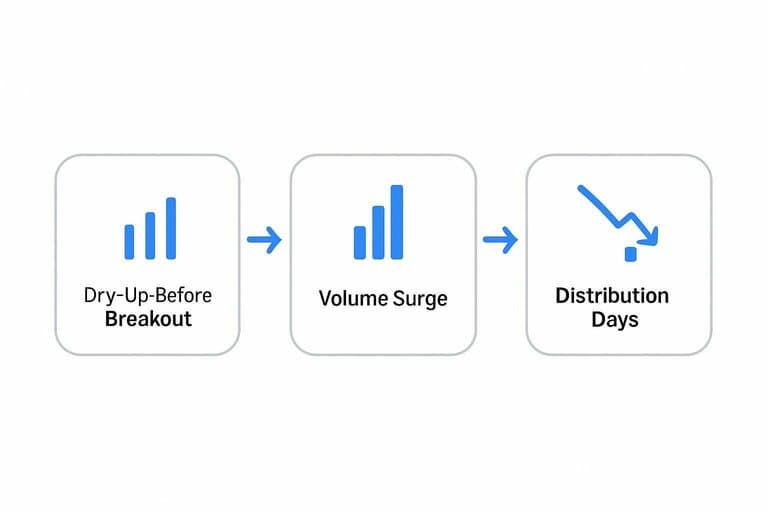
Dry-Up Before Breakout
Volume often contracts in bases and handles because the stock is being absorbed. Quiet trading matters because it suggests fewer motivated sellers remain.
You’ll see smaller daily volume bars, tighter closes, and fewer wide red days. The “nothing happening” feel is the point. It’s the market saying, “I tried to sell it down, and it wouldn’t go.”
A real breakout gets easier when sellers have already left the room.
Distribution Days
Institutional selling shows up in the indexes before it wrecks your breakout odds. You’re not trading one stock in isolation.
- Index down on higher volume
- Multiple big-cap leaders breaking support
- Rallies fading by the close
- Breakouts failing within 1–3 days
- Defensive sectors suddenly leading
When distribution stacks up, demand is rationed, and your “perfect” setup gets starved. Here’s IBD’s definition of distribution days and how they can flag a weakening uptrend.
Entry and Risk Rules
O’Neil’s edge comes from great stocks, but your survival comes from rules. You plan the entry, pre-place the exit, and accept small losses fast. Think “I can be wrong five times and still be fine.”
Where to Buy
Buy near the pivot because your risk is smallest there. Extended entries feel safer, but they quietly blow up your stop math.
- Mark the pivot price from the base.
- Set a buy zone: pivot to +2%.
- Define “extended” as +5% or more above pivot.
- Skip extended buys unless you can use a tight stop.
- Place the stop before you place the order.
If you buy extended, you’re trading hope, not a setup.
The 7–8% Stop
The classic O’Neil stop is simple: cut the trade at 7–8% below your entry. It protects you from the big break failures that look fine until they don’t.
Swing traders often tighten it to 3–6% when the base is tight or the market is choppy. The trick is picking one approach and using it the same way every time.
Consistency beats “perfect stops” because your stats need clean data.
Position Sizing Basics
Sizing is just risk control with arithmetic. You pick a dollar loss you can stomach, then let the stop set the share count.
- Set risk per trade at 0.5–1.0% of equity.
- Measure stop distance from entry to stop.
- Compute shares: risk ÷ stop distance.
- Round down, then place the order.
- Avoid leverage until you’re profitable.
Your stop decides the size, not your conviction.
Adding and Pyramiding
You add only after the stock proves you right. Adding early is how a small loss turns into a “why did I do that” loss.
One conservative rule: add a smaller tranche only after a 2–3% move in your favor, and only if your stop can move up. Never add if price is below your last buy.
If you feel urgency, you’re usually overtrading.
Turn O’Neil Into a Repeatable Breakout Plan
- Filter with CAN SLIM: prioritize true leaders (strong earnings/sales, something new, top relative strength) and skip laggards even if the pattern looks pretty.
- Grade the base: trade clean, constructive bases with tight action and a clear pivot; avoid wide, sloppy structures and late-stage bases.
- Demand the volume tell: look for a dry-up into the breakout and a decisive surge through the pivot, while staying alert to distribution days.
- Execute like a swing trader: buy as/just through the pivot, place the 7–8% stop where you’re proven wrong, size the position to the stop, and only add when the trade is working.
Frequently Asked Questions
Does William O’Neil’s method still work in 2026 with algorithmic trading and AI-driven markets?
Yes—most of O’Neil’s edge comes from timeless supply-and-demand behavior (breakouts, volume confirmation, and fast loss-cutting). What changes is execution: use tighter risk controls and more selective filters because false breakouts can be more common in headline- and liquidity-driven moves.
Do I need to follow every CAN SLIM letter to trade William O’Neil-style breakouts?
No—you usually need the core “leadership” signals (strong earnings/sales acceleration, relative strength, institutional sponsorship, and constructive price action). Many traders relax the “N” and “M” requirements as long as the stock is acting like a true leader and the risk is defined.
How do I scan for William O’Neil breakout candidates quickly?
Use a stock screener to filter for RS/relative strength near highs, strong recent earnings and sales growth, and price within ~5–10% of a 52-week high, then manually check for clean bases and volume expansion on the breakout day. Popular tools include TradingView screeners, MarketSmith, and Finviz (with custom filters).
What percentage move should I expect after a William O’Neil breakout, and how long does it usually take?
A solid breakout often delivers a 10–20% run in 2–8 weeks when the market tailwind is favorable, with bigger moves happening in true leaders during strong uptrends. If price can’t gain traction within the first 1–2 weeks or quickly loses the breakout level, it’s usually a low-quality breakout.
Can I use William O’Neil’s breakout approach for ETFs, crypto, or options instead of individual stocks?
ETFs can work but usually trend more slowly, so follow-through is often smaller and breakouts can be less explosive. Crypto and options can work only with tighter position sizing and predefined exits because volatility and gap risk are higher than in most O’Neil-style stock setups.
Find Breakout Leaders Faster
CAN SLIM checklists are only as good as the leaders you’re screening and the market regime you’re trading. Keeping RS, breadth, and rotation context updated daily is the hard part.
Open Swing Trading brings O’Neil-style leadership work into one daily workflow with RS rankings, breadth, and sector/theme rotation tools—get 7-day free access with no credit card.
Sources
- How To Spot A Stock Market Bottom: This Signal Marks All Major Lows — Investors.com (Follow-Through Day) — referenced in M Matters Most
- Stock Market Forecast: Is It Possible To Tell The Market's Top? — Investors.com (Distribution Days definition) — referenced in Distribution Days