William O'Neil vs Momentum Trading for Small Accounts
A clear comparison of William O’Neil’s CAN SLIM approach vs classic momentum trading for small accounts—fit-by-personality, entry/exit and risk rules, market-regime edge, and the real-world frictions of costs, time, and account constraints.
William O'Neil vs Momentum Trading for Small Accounts
A clear comparison of William O’Neil’s CAN SLIM approach vs classic momentum trading for small accounts—fit-by-personality, entry/exit and risk rules, market-regime edge, and the real-world frictions of costs, time, and account constraints.
If your account is small, the “best” strategy often fails for a boring reason: you can’t execute it cleanly. A few bad fills, one oversized loss, or too many trades can erase weeks of progress.
This comparison helps you choose between William O’Neil-style growth breakouts and simpler momentum systems based on what you can realistically do. You’ll see how the rules differ, where each has an edge in bull/chop/bear markets, and how costs, time, PDT, and sizing limits change the answer.
Who Each Fits
Small accounts don’t fail from bad ideas. They fail from friction.
O’Neil/CAN SLIM and pure momentum can both work, but they punish different weaknesses. Pick the style that matches your constraints, not your aspirations.
Small account reality
A “small account” is usually $500–$25,000, where every trade’s cost and wiggle matters. Below $25k in the U.S., PDT rules can cap you at three day trades per five days.
Position sizing gets cramped fast: a 1% risk rule on $2,000 is $20, which often forces tight stops or tiny share size. Slippage, spreads, and commissions hurt more because you trade smaller and absorb the same friction. That’s why volatility feels personal.
If your trades require frequent in-and-out moves, your account size becomes your strategy.
Core philosophy clash
O’Neil is “fundamentals first, then a clean base,” like a cup-with-handle breakout backed by earnings growth. You’re waiting for a proper setup, then acting hard and fast.
Pure momentum is “price and relative strength first,” buying what’s already moving and cutting what stops moving. You often accept uglier entries and more noise, because speed matters more than elegance.
The tradeoff is simple: O’Neil pays you for selectivity, momentum pays you for responsiveness.
Fast chooser checklist
If you’re choosing with a small account, optimize for what you can repeat weekly. Be honest.
- You have limited screen time
- You hate missing moves
- You prefer strict rules
- You tolerate fast drawdowns
- You can’t day trade freely
Choose the method your constraints don’t sabotage on Monday morning.
Rules Side-by-Side
Two traders can look at the same chart and follow totally different rulebooks. You want rules that you can execute when your account is small and your emotions are loud. Think “I can place this order in 30 seconds” versus “I need three more signals.”
Entry triggers
O’Neil entries are built around specific pivots, while momentum entries focus on fresh movement and quick validation. Your job is to know what must be true before you click buy.
- O’Neil: Buy at/above a defined pivot on a base breakout
- O’Neil: Confirm with volume surge and market trend alignment
- Momentum: Buy breakout through recent highs with range expansion
- Momentum: Buy pullback entry at VWAP/EMA reclaim after thrust
- Momentum: Confirm with relative strength and clean liquidity
If you can’t name the level before price hits it, you’re already late.
Exit logic
Both styles survive on exits, not entries. You need a rule that triggers even when you’re hoping it comes back.
- O’Neil: Hard stop at 7–8% below your buy price
- O’Neil: Sell into climactic action or obvious “blow-off” bars
- O’Neil: Exit on breaks of key moving averages in leaders
- Momentum: Trailing stop under swing lows or a fast moving average
- Momentum: Time stop if no follow-through in X days
Pick exits that fire automatically, because discretion fails under pressure.
Risk framework winner
Momentum trading usually has the clearer risk box for small accounts, because you can define invalidation tightly. A reclaim entry with a stop under the last swing low can risk 1–3%, which beats O’Neil’s classic 7–8% when your position sizes are small and commissions or spreads matter.
O’Neil is rules-based, but the “proper pivot,” “volume signature,” and “market confirmation” add judgment calls that many small accounts misapply. Start with the framework that forces small losses and fewer debates, then add nuance only after you’ve earned it.
Edge and Evidence
Both William O’Neil-style growth breakouts and pure momentum can work, but they win in different tape. Your job is matching the method to the regime, not arguing ideology.
Bull market performance
O’Neil tends to capture the truly explosive leaders earlier because it demands a fresh base breakout with institutional sponsorship. Momentum systems often show a higher hit rate, but the biggest winners arrive later because confirmation needs more time.
Payoff size is where O’Neil can separate, since one “monster” leader can pay for many scratches. If your account is small, that asymmetric upside matters more than being right often.

Chop and whipsaws
Sideways markets punish anything that needs follow-through, and small accounts feel every cut. Here’s how each style typically breaks.
- Buy breakouts that fail within days
- Rotate leaders too fast and churn
- Overtrade to “make it back”
- Treat noise as signal
- Ignore spreads and slippage
If you’re getting chopped twice a week, the market is telling you to trade less, not faster.
Bear market survival
O’Neil has explicit defense built in: raise cash when leaders break, respect the market trend, and avoid “hoping” through drawdowns. Momentum can survive too, but only if your rules allow going to cash fast or flipping short, which many small-account traders skip.
For small accounts, the edge is drawdown control, not bravado. The approach that keeps you mostly out during downtrends usually wins that decade.
Cost and Friction
Small accounts win or lose on boring math: spreads, commissions, and taxes. A “great setup” that costs 2% to enter and exit is not great.
| Friction | O’Neil / CAN SLIM style | Pure momentum (fast turnover) | Small-account edge | |—|—|—| | Commissions & fees | Lower trade count | Higher trade count | O’Neil | | Slippage & spreads | More selective entries | More market orders | O’Neil | | Turnover | Moderate | High | O’Neil | | Short-term taxes | Mostly short-term | Mostly short-term | Tie | | Execution complexity | Fewer moving parts | Timing sensitive | O’Neil |
If your account is small, turnover is the silent killer, so O’Neil wins on net returns.
Time and Complexity
Your constraint is rarely money. It’s time, attention, and clean execution when the market gets loud. Pick the approach whose workload you can repeat weekly, even on busy days.
Research workload
O’Neil-style trading asks for fundamental homework plus strict technical context, like “strong earnings, strong sales, proper base, then buy the breakout.” That means reading earnings, judging story quality, and confirming institutional sponsorship, often with IBD-style screens. Momentum trading shifts the burden from deep research to fast filtering. You rely on scanners for price/volume strength, relative strength, and liquidity, then validate with the chart and a risk plan. If you can’t consistently do earnings and base work, momentum is the realistic default.
Daily routine comparison
Use a routine you can finish in under 45 minutes on weekdays.
- Run O’Neil screens after the close and flag earnings leaders.
- Check bases, pivots, and volume clues; build a tight watchlist.
- Set alerts at pivots; plan size, stop, and add-on rules.
- Next day, buy only on valid breakouts; sell fast on rule breaks.
- Weekend: read earnings, update leaders, journal rule adherence. If that feels like homework, you’ll skip steps and pay for it.
Momentum can be shorter and more mechanical.
- Scan pre-market or after close for highs, RS, and volume spikes.
- Filter for liquidity and clean structure; pick 5–15 names.
- Define entry trigger, stop level, and target or trail.
- During the day, take triggered setups; cut quickly on failure.
- Weekend: review trades, tighten scanner rules, archive screenshots. Your edge comes from repetition, not research depth.
Execution difficulty winner
Under stress, simpler wins. Momentum trading usually has fewer “judgment calls” because your inputs are price, volume, and risk, not whether the company is a true “new leader.” O’Neil can be clean too, but it asks you to interpret bases, pivot quality, market direction, and fundamentals at once. If your time is limited, choose the method with fewer tools and fewer reasons to hesitate.
Account Constraints
Small accounts don’t just cap risk. They force different behavior, like fewer trades, wider stops, and less flexibility around entries.
A $3,000 account can’t run the same playbook as a $300,000 one, even with the same edge.
Position sizing limits
Small accounts hit math limits fast. When one share is $200, your “normal” 5% position becomes impossible.
You end up rounding sizes, skipping trades, or taking chunky positions that distort risk.
Partial fills add another problem. A tight breakout entry becomes a worse average price, or no fill at all.
Concentrated bets look efficient, then blow up. One gap-down can erase a month of progress.
PDT and access
Rules and plumbing shape your holding period. Your strategy adapts or it breaks.
- PDT limits day trades under $25k
- Cash settlement slows re-entry after sells
- Margin approval blocks shorting or leverage
- Share availability constrains some momentum names
- Commission and spreads bite more per trade
If you can’t trade freely, you need setups that pay for waiting.
Diversification tradeoff
With a small account, “diversification” is often pretend. You can’t own ten names if each minimum position is meaningful.
O’Neil-style investing usually wants multiple leaders. Think 5–10 positions to reduce single-stock shock.
Pure momentum trading can run concentrated, sometimes 1–3 positions. That’s fine with strict exits, but brutal during gaps.
If you’re undercapitalized, O’Neil adapts better. It pushes you toward fewer trades and more time, not more churn.
Pick by Goal
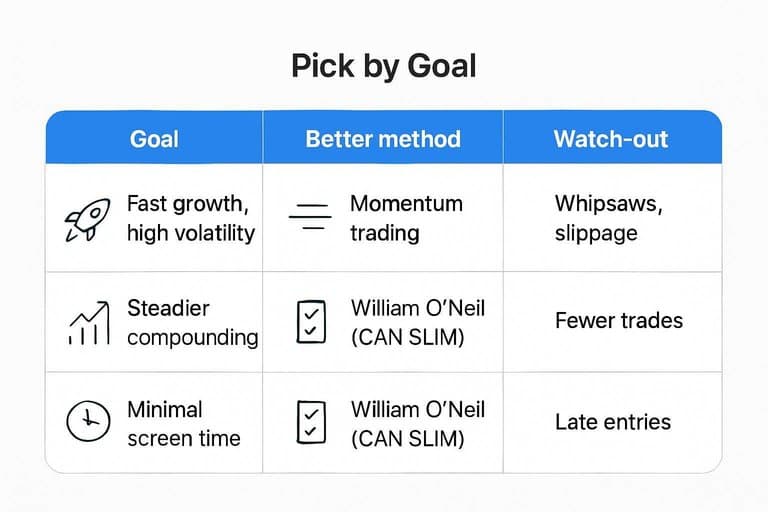
Your account size matters less than your goal and your tolerance for ugly drawdowns. Use this map to pick a method that fits what you’re really optimizing for.
| Goal | Better method | Why | Watch-out |
|---|---|---|---|
| Fast growth, high volatility | Momentum trading | Hits spikes early | Whipsaws, slippage |
| Steadier compounding | William O’Neil (CAN SLIM) | Filters for leaders | Fewer trades |
| Minimal screen time | William O’Neil (CAN SLIM) | Weekly prep works | Late entries |
| Learning price action fast | Momentum trading | Feedback is quick | Overtrading risk |
| Protecting small capital | William O’Neil (CAN SLIM) | Tight risk rules | Gaps still hurt |
Pick the winner for your goal, then build rules that punish you for breaking it.
Common Mistakes
Small accounts don’t blow up from one bad trade. They bleed out from repeatable errors you can prevent.
The trap is copying a “winning” style without matching its rules to your size, fills, and emotional bandwidth.
O’Neil pitfalls
O’Neil-style setups work when you enter on time and manage risk fast. Small accounts usually fail on execution, not chart reading.
- Buying late after the breakout runs
- Ignoring the market’s primary trend
- Averaging down “to improve basis”
- Falling for a great story, not earnings
- Skipping sell rules when it hurts
If your sell rules feel optional, you’re not doing O’Neil. You’re improvising.
Momentum pitfalls
Momentum trading pays you for speed and discipline. Small accounts often turn it into adrenaline trading.
- Chasing extended moves after the easy part
- Overtrading to “make it back”
- Using loose stops and hoping
- Ignoring liquidity and getting awful fills
- Trading news spikes with no edge
If you can’t exit cleanly, it isn’t momentum. It’s a trap.
Prevention rules
You need a few guardrails that work across both styles. Keep them simple, measurable, and non-negotiable.
Rule one: cap max loss per trade, like 0.5%–1% of account. Rule two: use a trade-quality checklist, like “trend, setup, liquidity, stop, catalyst.” Rule three: run a weekly review with metrics, like win rate, average win/loss, and max drawdown.
Your edge is what survives your worst week. Build for that.
Final Recommendation
Most small accounts should default to momentum trading because it’s simpler to execute and easier to risk-manage. O’Neil’s approach can work, but the screening and market-cycle judgment punish small mistakes.
- Choose momentum trading as your default if you need clean rules and fast feedback.
- Risk 0.5%–1% per trade, and stop out without debate.
- Trade the most liquid names you can afford, and skip thin movers.
- Track five stats weekly: win rate, average win, average loss, max drawdown, exposure.
Use O’Neil only when you can consistently spot true bases and sit through normal pullbacks without flinching.
Choose Your Default, Then Lock in the Rules
- Pick your “default” based on constraints: choose O’Neil if you can research earnings/leadership and wait for A+ breakouts; choose momentum if you need simpler, more repeatable signals and faster feedback.
- Set non-negotiables before your first trade: max risk per position, hard stop method, and a rule for adding/reducing exposure as conditions change.
- Run a 20-trade pilot with your exact tools and position sizes, then keep the strategy that you can execute with discipline, low friction, and controlled drawdowns.
Frequently Asked Questions
Is William O’Neil’s CAN SLIM strategy still relevant in 2026 for small accounts?
Yes—CAN SLIM’s focus on earnings-driven leaders and strict risk control still fits modern markets, especially when paired with today’s screeners and chart platforms. Most small accounts can apply it using liquid U.S. stocks and ETFs without needing large position sizes.
Do I need Level 2 data or real-time quotes to trade William O’Neil style effectively?
Usually not—end-of-day data plus next-day execution is enough for most CAN SLIM-style swing trades. Real-time quotes and Level 2 mainly help if you’re trying to fine-tune entries on breakout days or trade more actively.
How do I screen for William O’Neil stocks without paying for expensive tools?
Use free/low-cost screeners like TradingView, Finviz Elite, or Koyfin to filter for strong EPS growth, revenue acceleration, and relative strength, then confirm chart bases manually. You can also use IBD-style criteria with public earnings calendars and simple RS/52-week high filters.
What results should I expect from William O’Neil (CAN SLIM) compared to momentum trading?
Most traders should expect lumpy returns: long flat periods punctuated by a few strong winners, with performance heavily tied to bull-market regimes. A realistic benchmark is beating a broad index over full cycles while keeping drawdowns controlled via tight sell rules.
How long does it take to learn William O’Neil’s method well enough to trade with real money?
Most people need 6 to 12 weeks to learn the rules and chart patterns, then 3 to 6 months of journaling and review to execute consistently. Start with small position sizes (or paper trading) until you can follow sell rules without exceptions.
Find True Breakout Leaders
Whether you lean O’Neil-style breakouts or simpler momentum rules, small accounts win when you focus on real leadership and the right market regime.
Open Swing Trading surfaces potential leaders with daily RS rankings, breadth, and sector/theme rotation context so you can build a clean watchlist in minutes—get 7-day free access with no credit card.
Sources
- Investor’s Business Daily — When To Sell Stocks (7%–8% sell rule, profit-taking rules, 8-week hold rule) — referenced in Exit logic
- Investopedia — Bid-Ask Spread (implicit trading cost; liquidity link) — referenced in Momentum pitfalls